 Arjun Mehta
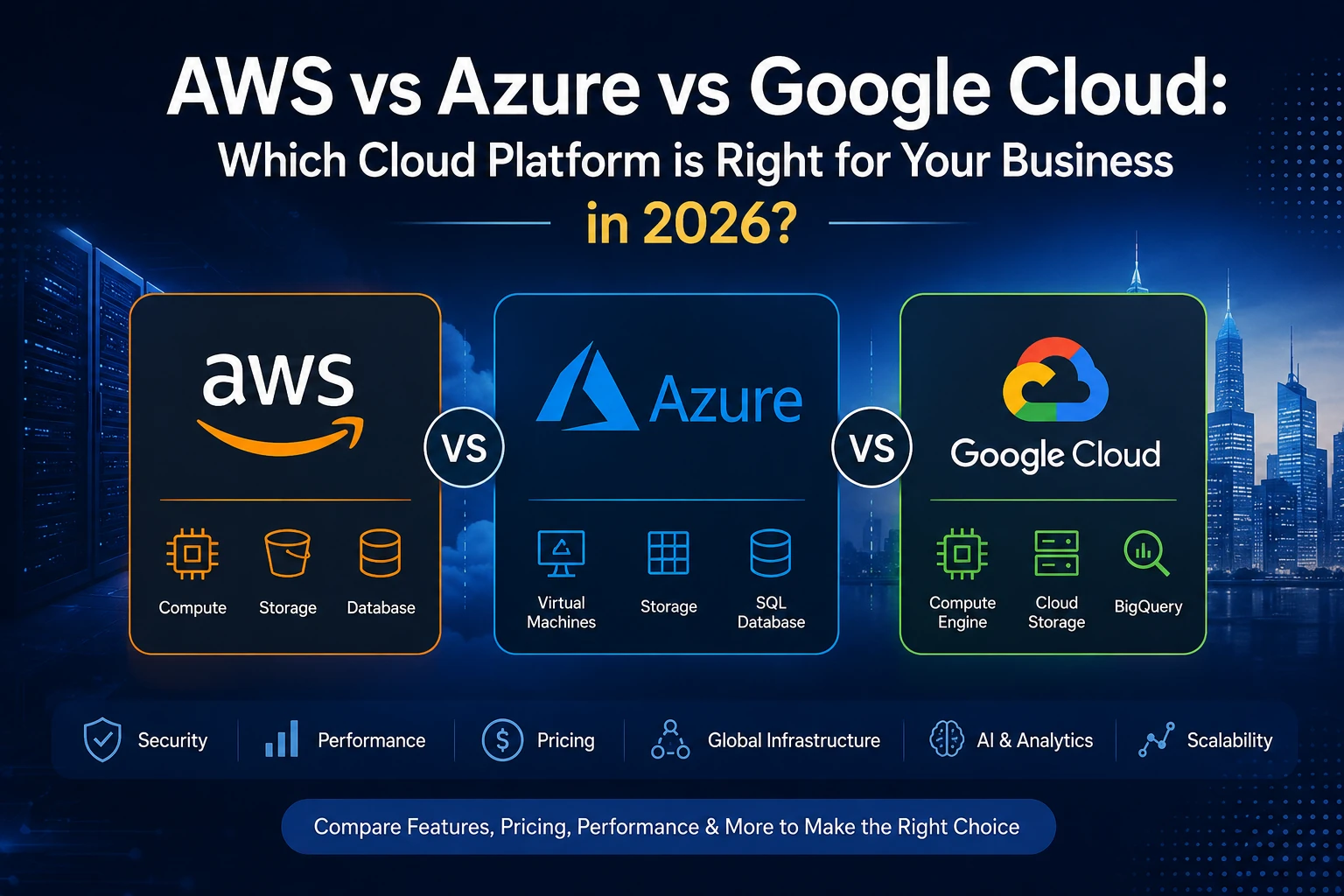
Choosing the right cloud platform can significantly impact your business's scalability, security, performance, and costs. In this comprehensive comparison, we evaluate AWS, Microsoft Azure, and Google Cloud across pricing, AI capabilities, Kubernetes, networking, storage, disaster recovery, and enterprise features to help you make an informed decision in 2026.
Choosing a cloud provider used to be simple: pick the biggest name and move on. That approach doesn't hold up anymore. AWS, Microsoft Azure, and Google Cloud have all matured into sprawling platforms with overlapping services, different pricing logic, and increasingly aggressive AI offerings — which means the "right" choice now depends entirely on your workload, your team's skills, and your growth plan, not just brand recognition.
For business owners, CTOs, and IT managers, that's the real problem in 2026: there isn't a single correct answer, but there is a correct answer for your business. Pick wrong, and you're looking at expensive re-architecture, surprise egress bills, or a migration project eighteen months from now that nobody budgeted for. This guide breaks down how AWS, Azure, and Google Cloud actually compare — features, pricing structure, and real operational trade-offs — so you can make a decision you won't need to reverse.
AWS vs Azure vs Google Cloud: The Current Landscape
AWS, Azure, and Google Cloud — often called the "Big Three" — together account for roughly two-thirds of global cloud infrastructure spending. AWS holds the largest share at around 31%, with Azure at 23-25% and growing faster, and Google Cloud at 12-13%, the smallest of the three but currently posting the fastest year-over-year growth rate among the leaders.
That growth gap matters more than the raw market share numbers. Google Cloud has been growing revenue at roughly 28% year-over-year, ahead of Azure's 25% and AWS's 18% — a sign that GCP's AI and data analytics investments are translating into real enterprise adoption, not just headlines. Meanwhile, multi-cloud adoption has reportedly climbed to around 89% of enterprises, meaning most mid-size and large businesses no longer think of this as an "either/or" decision at all.
For a small or mid-sized business, the practical takeaway isn't "go with whoever's biggest." It's that all three platforms are mature, well-funded, and actively competing on price and AI capability — which is good news for buyers, but only if you know what you're actually comparing.
Key Differences That Actually Matter for Your Business
Forget the marketing pages for a moment. Here's where the three platforms genuinely diverge in ways that affect your day-to-day costs and operations:
Service breadth vs. focus. AWS offers the widest catalog of services and the largest partner and talent ecosystem, which matters if your roadmap is unpredictable and you want a service for everything. Azure and GCP are more curated, which can mean less choice but also less decision fatigue.
Pricing transparency. Google Cloud applies automatic sustained-use discounts without requiring upfront commitments, while AWS and Azure generally rely on Reserved Instances or Savings Plans that require capacity planning ahead of time. If your usage is unpredictable, that difference alone can change your effective hourly rate.
Microsoft ecosystem lock-in (or lock-in avoidance). If your business already runs on Microsoft 365, Windows Server, or SQL Server, Azure's hybrid licensing benefits can produce real savings that AWS and GCP simply can't match — but if you're not in that ecosystem, that advantage is irrelevant to you.
AI strategy differences. AWS offers model choice through Bedrock (including Anthropic's Claude, Meta's Llama, and others), Azure leans on its exclusive OpenAI partnership for GPT-model access, and Google Cloud goes all-in on its own Gemini models through Vertex AI, backed by custom TPU hardware. Your AI roadmap should drive this decision more than general brand preference.
Kubernetes and container tooling. Google originated Kubernetes, and GKE is widely regarded as the most mature managed Kubernetes offering, while AWS EKS and Azure AKS differ mainly in control-plane pricing and integration depth.
Hidden costs. All three providers give roughly the first 100GB per month free for data egress, then charge in the $0.09–$0.12 per GB range after that — a cost that's easy to overlook during planning and painful to discover on an invoice.
Common Problems Businesses Face When Choosing (or Switching) Cloud Providers
Most cloud regret doesn't come from picking the "wrong" platform in absolute terms — it comes from skipping the homework. The recurring problems we see:
Security misconfiguration, not platform weakness. All three providers offer enterprise-grade security tools, but the majority of cloud breaches still trace back to misconfigured permissions, exposed storage buckets, or missing MFA — not a flaw in AWS, Azure, or GCP itself.
Performance issues from wrong-sized infrastructure. Businesses frequently over-provision "just in case" or under-provision to save money upfront, both of which create performance and cost problems that surface months later.
Maintenance complexity with no dedicated owner. Patching, scaling, backups, and monitoring don't happen automatically just because you're "in the cloud." Without a clear owner, these tasks quietly stop happening.
Underestimated migration scope. Lifting an application to a new cloud is rarely just a server move — dependencies, data transfer windows, DNS cutover, and application compatibility testing all add time that's easy to underestimate.
Multi-cloud sprawl without a strategy. Running workloads across two or three providers without a deliberate reason often increases cost and operational overhead instead of reducing risk.
Best Practices for Choosing and Running Your Cloud Infrastructure
A few practical, provider-agnostic recommendations that hold up regardless of which platform you choose:
Match the platform to your actual workload, not your assumptions. AI/ML-heavy and data analytics workloads tend to fit Google Cloud well; Microsoft-centric enterprises usually get more value from Azure; broad, varied workloads with no single dominant pattern are often easiest on AWS given its service breadth.
Right-size before you optimize. Most cost savings come from matching instance types to actual usage, not from chasing the cheapest sticker price across providers.
Use commitment discounts deliberately, not by default — reserved capacity only saves money if your usage is genuinely predictable.
Plan for data egress costs explicitly before migration, especially if your architecture involves frequent cross-region or cross-cloud data movement.
Treat security as a configuration discipline, not a one-time setup step — recurring audits catch the misconfigurations that cause most real-world incidents.
Document your migration plan before you start, including a rollback path, rather than treating cloud migration as a one-way door.
How Sysop Solutions Helps
Sysop Solutions works across AWS, Google Cloud, and Microsoft Azure — we're not tied to a single hyperscaler, which means our recommendations are based on what fits your workload, not which platform we happen to resell. Our cloud infrastructure services cover the practical work that turns "we have a cloud account" into "our infrastructure actually runs reliably":
Cloud consulting services to assess your current setup (or your starting requirements, if you're not yet in the cloud) and recommend a platform and architecture based on your workload, budget, and team's technical capacity — not a one-size-fits-all template.
Cloud migration services for businesses moving from on-premise infrastructure, a legacy host, or between cloud providers, with a defined migration window and rollback plan instead of a high-risk cutover.
Multi-cloud solutions for businesses that have a genuine reason to run workloads across more than one provider — including cost monitoring so multi-cloud doesn't quietly become multi-cloud sprawl.
Ongoing infrastructure management covering monitoring, patching, scaling, and security configuration review, so cloud maintenance has an actual owner instead of being everyone's job and no one's job.
FinOps and cost optimization, reviewing your existing cloud spend for over-provisioned resources, missed commitment discounts, and avoidable egress costs.
We're a lean, accountable team — when you work with Sysop Solutions, you're dealing with the people actually doing the work, not a support queue.
Real Business Benefits of Getting This Right
Choosing the right cloud platform — and configuring it properly — produces benefits you can actually measure:
Performance: Workloads sized and architected for their actual usage pattern run faster and more predictably than over-provisioned or mismatched infrastructure.
Cost control: Proper use of commitment discounts, right-sizing, and egress planning typically reduces cloud spend without reducing capability — the savings come from eliminating waste, not cutting corners.
Reliability: Infrastructure with an actual maintenance owner experiences fewer unplanned outages than infrastructure that's "set and forgotten."
Security: Regular configuration review catches the access and permission issues that cause most cloud security incidents, before they become incidents.
Conclusion
There's no universal winner in the AWS vs Azure vs Google Cloud comparison — and any guide that tells you otherwise is oversimplifying. AWS makes sense when you want the widest service catalog and the largest talent pool to hire from. Azure makes sense when your business already runs on Microsoft tools or needs deep OpenAI integration. Google Cloud makes sense when AI, data analytics, or Kubernetes-native architecture are central to what you're building. The right choice depends on your workload, your team's existing skills, and where your business is headed — not on which platform has the biggest marketing budget.
What matters more than the platform you pick is how well it's configured, migrated, and maintained afterward. That's the part most businesses underestimate.
Ready to Choose the Right Cloud Platform for Your Business?
If you're weighing AWS, Azure, and Google Cloud and want an honest read on which one actually fits your workload — not a sales pitch for whichever platform pays the best referral fee — talk to Sysop Solutions. We'll assess your requirements, recommend a platform and architecture, and handle the migration and ongoing management if you need it.
Explore our cloud infrastructure and migration services at sysophost.com.
Comments
No comments yet. Be the first to comment!