 Neha Sharma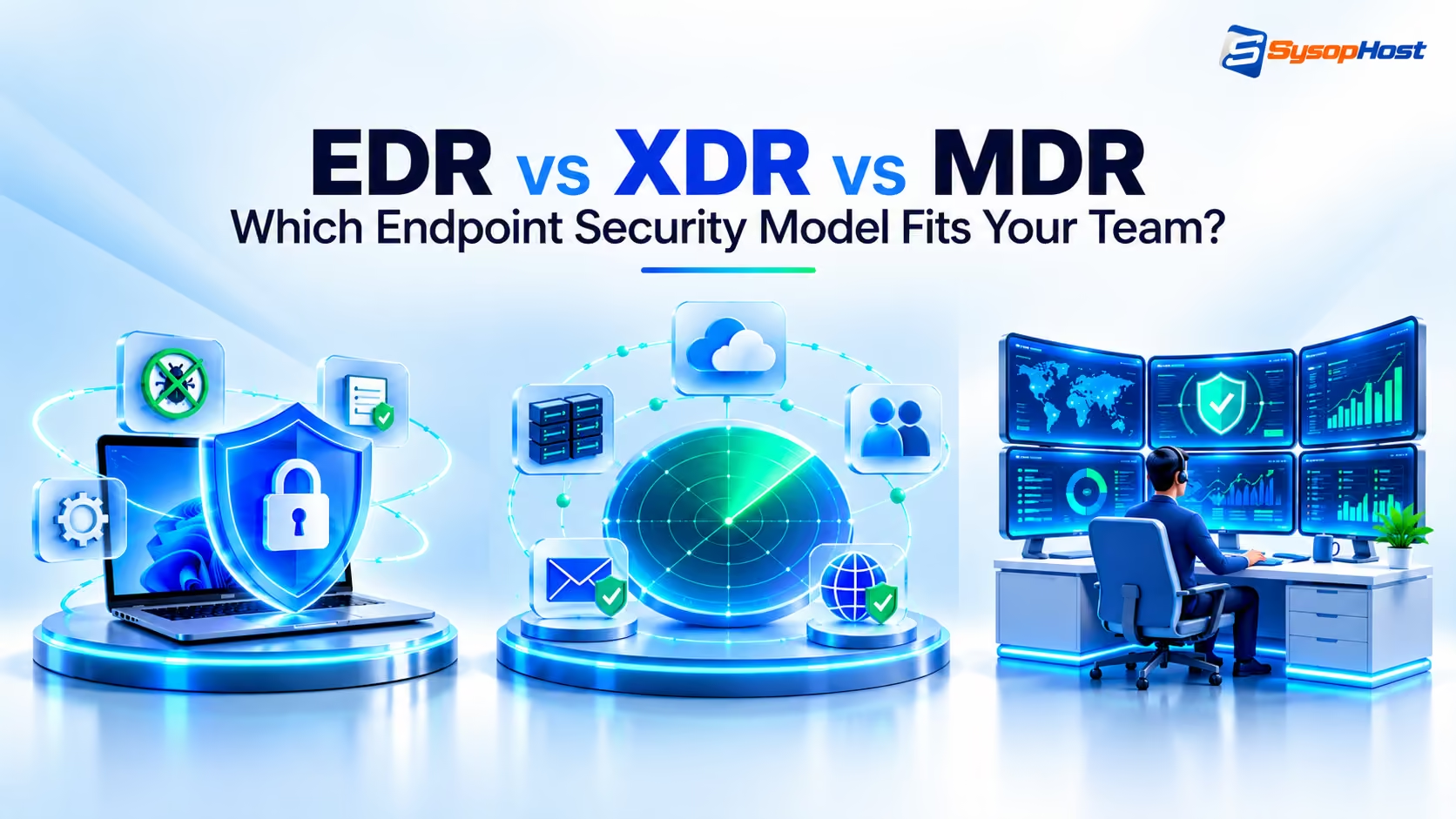
Vendors blur EDR, XDR, and MDR until all three sound identical — and teams overbuy, underbuy, or stack overlapping tools. This guide separates the three models by what they actually deliver — endpoint depth, cross-layer breadth, and human operations — then matches each to a team size and budget, with 2026 pricing ranges and a practical decision matrix for lean IT teams.
Buying endpoint security in 2026 is harder than ever — not because any of it is mysterious, but because vendors deliberately blur the lines. The result, as one 2026 industry guide put it, is organizations buying EDR and XDR from different vendors, then hiring a third party for a 24/7 SOC, and ending up with overlapping capabilities nobody uses.
The acronyms — EDR, XDR, MDR — are not the same product at three price points. They are three different answers to different problems: depth, breadth, and people. Choosing correctly depends less on the technology and more on an honest question most buyers skip: who is going to watch the alerts?
This guide defines the three models in plain English, compares 2026 costs and staffing realities, and gives you a decision matrix matched to team size.
Key Takeaways
EDR = detection and response focused on endpoints. XDR = correlation across endpoint and other security telemetry. MDR = a managed service that monitors and responds within the coverage and authority defined by contract.
The technology choice matters less than the operating model: without an alert owner or configured automated response, detections can go unactioned.
One provider's published 2026 planning ranges put EDR tools at roughly $3–18 per endpoint/month and MDR services at $15–50+; scope, tooling, and contract terms can change the price substantially.
For teams without dedicated security coverage, a managed service may close the monitoring gap. Confirm whether it includes endpoint tooling or supports your existing stack before buying overlapping licenses.
Multi-vendor EDR, XDR, and MDR can work, but require supported integrations, clear incident ownership, and a plan to avoid duplicate coverage and costs.
The Three Models in Plain English
Model | What it is | Scope | Who operates it |
|---|---|---|---|
EDR | Software that records endpoint activity, detects suspicious behavior, and enables response actions | Endpoints: laptops, servers, workloads | Your team or a contracted service provider |
XDR | Platform that correlates endpoint data with other telemetry for broader detection; may be native to one vendor or integrate third-party tools | Endpoint + email + identity + network + cloud, depending on integrations | Your team or a managed provider |
MDR | A managed detection-and-response service using provider tooling or compatible customer tooling; coverage and response authority vary by contract | The assets and telemetry included in the service scope | Provider analysts, within contracted coverage |
A useful mental model: EDR is depth, XDR is breadth, MDR is people. Nothing more — and nothing less.
EDR: Deep Visibility on the Endpoint
Endpoint Detection and Response tools continuously monitor endpoint activity — process executions, file changes, registry modifications, network connections, script and command-line behavior — and can surface suspicious behaviors that signature-based antivirus may miss. Modern EDR products may also enable response actions: isolate a machine, kill a process, remove persistence, or roll back ransomware-encrypted files where supported.
Strengths:
Provides detailed visibility into endpoint activity; its value depends on complete agent coverage, configuration, and a plan to investigate and act on alerts.
Sharp forensic depth — you can reconstruct an incident from one machine's activity timeline.
Fast to deploy; most products are agent-only, live in days.
Limits:
Limited visibility into activity that does not touch an instrumented endpoint. Email, identity, cloud, and network integrations can add context, but are not inherent to every EDR product.
Alerts need an owner or a response plan. Without human triage or configured automation, alerts can accumulate in a console nobody has time to review.
XDR: Correlation Across Layers
Extended Detection and Response correlates telemetry from multiple security layers — typically endpoint, email, identity, network, and cloud — to add context to detections. Native XDR is closely integrated with one vendor's products; Open XDR can ingest telemetry from third-party tools. A suspicious login, a mailbox rule change, and an anomalous file download may be grouped into a more actionable incident when the relevant integrations and detections are configured.
Strengths:
Correlation across layers can reduce alert noise and improve incident context when integrations and detections are well configured.
A unified console and incident timeline can simplify triage; the degree of unification depends on the platform and its integrations.
Can be operated by an internal team or paired with MDR; some MDR providers use XDR platforms, but tooling and integrations vary.
Limits:
Integration depth varies. Native XDR may work best with its vendor's tools, while Open XDR is designed to integrate third-party sources. Check connector coverage, data fidelity, response actions, and portability before choosing.
Pricing varies by vendor and may be based on endpoints, platform tiers, bundles, data ingestion, or retention.
An XDR platform alone does not guarantee monitoring or response. Your team or a contracted managed provider still needs to operate it.
MDR: Buying the Operation, Not Just the Tool
Managed Detection and Response is a service, not just a product category. Depending on the contract, provider analysts may monitor telemetry, investigate alerts, and contain threats using provider-supplied or compatible customer tooling. Coverage hours, assets monitored, response actions, and escalation procedures vary; verify them rather than assuming every MDR offer includes 24/7 response.
Why it exists: continuous security monitoring requires coverage planning, escalation paths, and qualified staff — a recurring operating burden many small and mid-sized teams cannot justify. The security staffing shortage can make it harder to hire for that coverage. Sophos' 2026 State of Ransomware report says roughly 1 in 3 surveyed smaller organizations stopped a ransomware attack before encryption; treat this as a survey finding, not proof that a particular product or service would prevent an attack.
Strengths:
Continuous coverage, including nights and weekends, when the contracted service tier provides it.
Expertise on demand: your team does not need to master threat hunting.
Potentially more predictable operating costs; check onboarding, minimums, data fees, incident-response charges, and renewal terms.
Limits:
You outsource trust as well as capability. Response actions happen in your environment — SLAs, escalation contacts, and permissions need real diligence.
Provider quality and scope vary. Ask which assets and data sources are monitored, what actions analysts may take, and who authorizes containment.
MDR does not remove the need for security hygiene. Patching and remediation may be outside the service scope, so confirm what the provider will execute versus recommend.
What Endpoint Security Costs in 2026
Ballpark, per endpoint per month (verify quotes; pricing varies by market and deal structure):
Model | Typical range | What drives the cost |
|---|---|---|
EDR tool | ~$3–18 | Per-seat licensing; feature tier (prevention vs. full EDR) |
XDR platform | Varies; may be endpoint-, tier-, bundle-, or data-volume priced | Seats, included integrations, telemetry ingestion, and retention |
MDR service | ~$15–50+ | Per endpoint; coverage scope; response depth; SLA tier |
Two cautions from 2026 buying guidance:
Published prices are negotiation anchors, not quotes — expect meaningful variance by region, term, and deal size.
Check logging and storage costs. Some XDR offerings charge separately for telemetry ingestion or retention; confirm what is included and model growth before enabling high-volume data sources.
Decision Matrix: Match the Model to Your Team
Your situation | Recommended baseline | Reasoning |
|---|---|---|
No dedicated security staff (IT team of 1–3 wearing many hats) | Supported endpoint protection, with MDR considered if alert coverage is missing | Confirm who monitors alerts, whether MDR includes tooling, and what response actions the provider is authorized to take. |
IT team of 3–10, one part-time security lead | EDR with a defined operating plan; consider co-managed MDR | Keep internal ownership where useful; contract for coverage or expertise the team cannot provide. |
Security team with business-hours coverage but no 24/7 rota | EDR/XDR platform with an on-call or MDR plan | Extend response coverage if the organization's risk and availability requirements justify it. |
Dedicated SOC with mature detection operations | Evaluate self-operated XDR if broader telemetry adds value | Choose based on integration quality, use cases, and staffing capacity—not analyst count alone. |
Regulated industry, audit-heavy (finance, healthcare) | Select tools and services against the actual risk and regulatory scope | XDR/MDR may support detection, response, and evidence gathering, but neither is generically required or sufficient for compliance (NIS2 Article 21). |
Treat the matrix as a starting point, not a staffing rule. Risk exposure, asset coverage, internal response capacity, existing tooling, budget, and regulatory scope matter more than headcount alone. Neither XDR nor MDR by itself guarantees regulatory compliance.
A common failure is buying a capable EDR tool without assigning anyone to monitor and respond to its alerts. The console becomes a to-do graveyard, alerts go unactioned, and when an incident happens, the evidence may be sitting in an unread inbox.
Common Buying Mistakes
Combining tools without an integration and ownership plan. Different vendors can work together through supported Open XDR or MDR integrations, but unplanned stacks can create separate consoles, log silos, duplicate costs, and unclear incident ownership. Confirm data and response-action support before buying.
Comparing on features instead of operations. The differentiator that matters in an MDR contract is response time and response authority — who clicks the "isolate" button at 3 a.m.
Buying XDR before you can use its breadth. If phishing or stolen credentials are key risks, make sure email and identity controls are covered; EDR alone may not see activity before it reaches an instrumented endpoint. XDR adds value only when the relevant sources are integrated and someone can act on the detections.
Forgetting endpoint hygiene in the contract. EOL operating systems, unpatched software, and over-broad admin rights defeat any of these models.
A Practical Roadmap
Now: inventory endpoints and deploy supported endpoint protection/EDR based on asset risk and compatibility. Assign alert ownership and define how incidents will be escalated and handled.
Next 3–6 months: assess gaps in identity, email, network, and cloud telemetry. Add integrations or XDR where they improve detection and investigation; a single vendor is not a prerequisite for every XDR approach.
6–12 months: formalize an in-house on-call rotation or contract for managed coverage. Define and rehearse response runbooks, service hours, isolation criteria, contact paths, and evidence preservation.
Ongoing: quarterly review of detections actually actioned — coverage you do not act on is coverage you do not have.
Actionable Checklist
Inventory every endpoint (including servers and contractor devices) — you cannot protect what you have not counted
Prioritize supported endpoint protection/EDR coverage and assign an owner for its alerts
Decide honestly: who watches alerts at 2 a.m. on New Year's Eve? If nobody does, evaluate an on-call or managed coverage option, including MDR
Shortlist 3 providers; for MDR, compare SLA, response authority, and coverage of servers/cloud — not just feature lists
Verify the pricing unit and included ingestion/retention for each shortlisted XDR platform
Run a 30-day pilot with a red-team or penetration-test alert before signing any multi-year term
Document response escalation: who authorizes isolation, outage, or device wipe
Schedule the quarterly "what did we actually detect and act on" review
The Bottom Line
EDR, XDR, and MDR describe different parts of a security operating model: endpoint detection and response, cross-layer detection, and managed monitoring/response. They are not a mandatory purchase sequence. Start with the risks and assets you need to cover, then decide who will operate the controls and whether broader telemetry or a managed service is justified.
For businesses without a dedicated security function, the practical starting point is supported endpoint protection plus a clear monitoring and incident-response plan. MDR may fit when internal coverage is insufficient, but compare its tooling, hours, asset scope, and response authority with your actual needs.
Discuss Your Endpoint Security Requirements
Talk with SysopHost about your cybersecurity needs and the coverage your team requires. Confirm available services, coverage hours, and response scope directly with the team.
Talk to a Security EngineerWhat is the difference between EDR, XDR, and MDR?
EDR is software focused on detection and response at endpoints. XDR correlates endpoint signals with other security telemetry; native XDR is tightly integrated with one vendor, while Open XDR can integrate third-party tools. MDR is a managed service whose monitoring hours, tools, and response actions depend on the contract. In short: EDR is endpoint depth, XDR is cross-layer context, and MDR is managed operation.
Comments
No comments yet. Be the first to comment!