 Priya Nair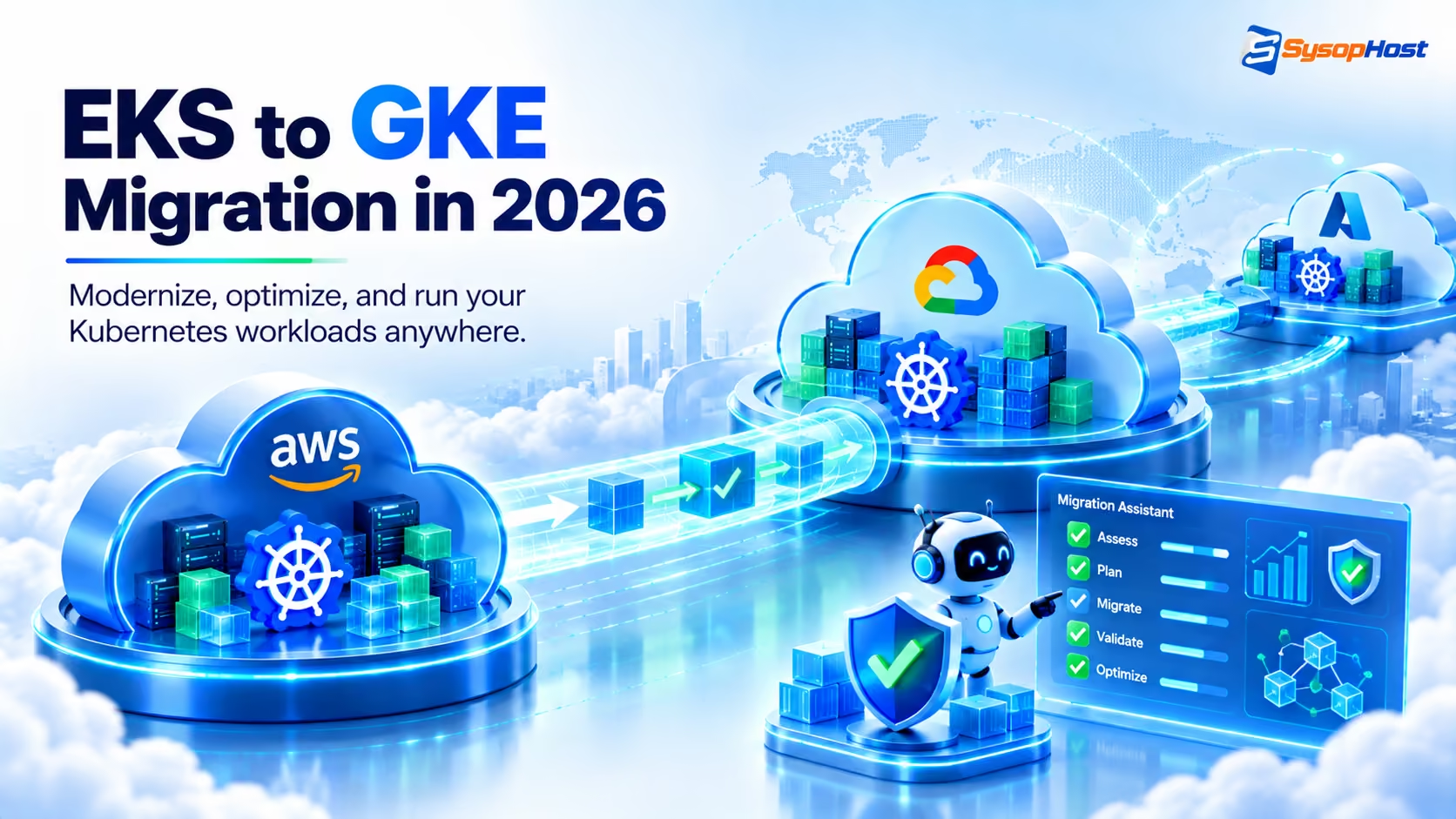
In one week, Google launched a universal work agent and brought AI-assisted EKS-to-GKE migration into public preview, while Microsoft opened multicloud Kubernetes onboarding on Azure Arc. What these three announcements mean for teams weighing a cloud switch — and what to verify before acting on any of them.
Three announcements in four days, all aimed at the same thing: your workloads, wherever they currently run.
On October 8, Google Cloud's Thomas Kurian unveiled the Gemini agent at Gemini at Work 2026 — a universal work agent spanning knowledge work to coding from a single prompt box. Days earlier, Google had brought its GKE agentic migration tooling into public preview as part of the new Google Cloud Modernize portfolio — the AI-assisted path from EKS to GKE that led that week's cloud coverage. And on October 7, Microsoft put Azure Arc multicloud Kubernetes onboarding into public preview, auto-discovering EKS and GKE clusters into Azure's control plane.
Read together, the message is unmistakable: the hyperscalers have accepted that estates are multicloud, and they are now competing on who makes it easiest to arrive — and to be managed from — their cloud. For teams already weighing a switch, the tooling tailwind is real. For everyone else, it is a week that clarifies where cloud strategy is heading.
Quick answer: Google's October 2026 moves (Gemini agent + agentic EKS-to-GKE migration with governance) lower the cost of moving Kubernetes to GCP; Azure's Arc Multicloud Connector preview lowers the cost of governing EKS/GKE clusters from Azure without moving them. Neither removes the fundamentals — inventory, egress math, validation, rehearsed cutover — but both are worth a proof-of-concept if a switch or unified governance is on your 2026 roadmap. Treat preview features and launch pricing as provisional until verified.
Key takeaways:
Gemini agent (Oct 8, 2026): single prompt interface with org business context, from Q&A to coding — evaluate data-governance terms before piloting.
GKE agentic migration (public preview Oct 5): AI-assisted EKS→GKE across four phases — assess and discover, plan and build, migrate, optimize — with built-in governance.
Azure Arc Multicloud Connector (public preview, Oct 7): auto-discovers EKS/GKE, enrolls in Arc-enabled Kubernetes for unified management and policy.
All three fit the 2026 pattern: cloud-to-cloud is the default migration, and vendors compete on arrival experience.
Preview status, egress costs, and second-cloud operational load still decide real TCO — run the numbers before the narrative.
What was actually announced
1. Gemini agent for work (Google Cloud, October 8, 2026). Adapted from Kurian's keynote: one universal agent that answers questions, handles knowledge work, creates media, and writes code from a single prompt window, grounded in organizational business context. The pitch is that work starts in the prompt box rather than across a dozen apps. For infrastructure teams, the relevant questions are narrower than the keynote: which data sources it can reach, how permissions and audit work, what the model lifecycle looks like (Google documents Gemini 3.x model versions with 12-month availability windows), and what it costs at team scale. Treat the agent as a powerful new insider — provision it like one, with least privilege and logging.
2. GKE agentic migration for EKS-to-GKE (Google Cloud; plugin September 24, public preview October 5, 2026). Google's architecture guide structures EKS→GKE work in four phases: assess and discover; plan and build a foundation; migrate workloads; optimize. The "agentic" layer — an open-source agent plugin folded into the new Google Cloud Modernize portfolio in public preview — adds AI assistance to the migration itself: discovery mapping, manifest translation, and governance guardrails such as human approval gates and GitOps pull requests, rather than leaving teams with docs and scripts. Press coverage (CloudComputing-News, Oct 7) frames it as Google directly targeting AWS Kubernetes footprints. Practically: if GKE's networking, pricing, or AI/GPU story already tempted you, the migration friction just dropped a notch. If EKS serves you well, this changes nothing about your renewal.
3. Azure Arc Multicloud Connector for Kubernetes (public preview, October 7, 2026). The connector auto-discovers EKS and GKE clusters from connected accounts and onboards them to Arc-enabled Kubernetes (both cluster onboardings are in public preview) — so Azure becomes the management and governance plane for clusters that physically run elsewhere, with Azure policy, security, and inventory services extended outward. Microsoft's docs note the connector also covers EC2 onboarding (with read/write access requirements worth reviewing) and that GCP support remains preview. The honest framing: this is governance-without-migration — attractive when compliance or operations want one pane of glass, but it adds an Azure dependency and preview-stage rough edges to clusters that were previously single-cloud simple.
Why all three landed in the same week
This is not coincidence — it is strategy converging on the 2026 reality:
Cloud-to-cloud is the default migration. Most enterprises finished their first on-prem→cloud move years ago; current work is switching providers, consolidating accounts, and modernizing platforms. Vendors that smooth arrival win net-new consumption.
Kubernetes is the portable battleground. Containerized workloads move more credibly than VM estates, so EKS→GKE tooling and cross-cloud governance both target the same cluster-owning buyer.
AI is the wedge. Agents (Gemini) and AI-assisted migration both promise to compress the labor cost that has historically made switches prohibitive. Whether the assistance is reliable at your complexity level is a proof-of-concept question, not a keynote claim.
Governance sprawl hurts. Multicloud estates accumulate per-cloud IAM, policy, and inventory silos. Whoever unifies the control plane — Arc from Azure, Anthos-style tooling from Google — captures operational gravity even without capturing the workloads.
Net: expect every hyperscaler to keep lowering their inbound friction while raising their management gravity. Portability improves; neutrality does not automatically follow.
Announcement comparison: what each one changes
Announcement (date) | What it is | Who benefits most | Biggest string attached |
|---|---|---|---|
Gemini agent, Google Cloud (Oct 8, 2026) | Universal work agent over org context: Q&A, knowledge work, media, code | Teams standardized on Google Workspace + Cloud wanting one assistant surface | Data-governance terms, permission scoping, and per-seat pricing to verify |
GKE agentic migration (plugin Sep 24; preview Oct 5, 2026) | AI-assisted EKS→GKE path: assess, plan, migrate, optimize with governance | EKS shops already considering GKE for price, networking, or GPU capacity | Migration egress + re-platforming effort; validates only the Google direction |
Arc Multicloud Connector for K8s (preview, Oct 7, 2026) | Auto-discovery + Arc onboarding of EKS/GKE for unified management | Multicloud estates needing one governance pane without moving workloads | Preview maturity; broad cross-cloud IAM grants; Azure becomes the front door |
Notice what is missing: nobody announced cheaper egress, and nobody announced a neutral standard. Every improvement is directional — toward one vendor's arrival experience or governance plane. That is rational vendor behavior, and it is why your portability disciplines (containers, IaC, open formats, controlled DNS) matter more than any single launch. Announcements change the price of specific moves; only architecture changes your freedom to choose.
Also note the sequencing signal. Google paired an agent (stay-and-build-here appeal) with a migration tool (come-here appeal) in the same week — covering both the team that wants AI help where it stands and the team ready to move. Microsoft answered with governance without migration for estates that will not consolidate soon. If your 2026 roadmap includes either AI-assisted operations or estate consolidation, at least one of these deserves lab time; if it includes neither, the rational response is a watching brief, not a migration.
What it means if you run Kubernetes today
If you are happy on EKS: nothing to do this month. Note the GKE option value for your next renewal or GPU-capacity crunch, and evaluate Arc only if cross-cloud governance pain is already real — adopting a second control plane to solve a problem you do not have is negative progress.
If GKE already tempted you: the agentic migration path deserves a scoped PoC. Migrate one non-critical service end-to-end through the four phases, measure actual effort versus the documented path, validate networking (VPC design, ingress, DNS), storage classes, IAM mapping, and GPU/accelerator availability in your target regions. Compare TCO with egress modeled — the migration itself pays source-egress rates.
If you already span clouds: the Arc preview is worth a lab trial for inventory and policy consistency, with eyes open on preview limits, permission scopes (review required IAM grants), and the question of whether your team wants Azure as the governance front door. Alternatives (Terraform + policy-as-code + per-cloud native tooling) remain viable and avoid the extra dependency.
A note on leverage: even if you move nothing, inbound-migration tooling is negotiating leverage. A credible, costed alternative — "we can reach GKE in one quarter with assisted tooling" — changes renewal conversations more than any benchmark slide. Keep the PoC results and TCO model on file; the option is worth money whether or not you exercise it. The same applies to governance: demonstrating that Arc could unify policy across clouds pressures incumbent vendors on management-suite pricing, regardless of which pane of glass you ultimately choose.
If you are deciding VPS versus hyperscaler Kubernetes: these announcements do not change the SMB calculus. Managed Kubernetes (any cloud) still bills for control plane plus nodes plus egress; a VPS or managed host still wins for predictable, modest workloads. Revisit only when scale, managed-service depth, or hiring dictates.
Caveats before you act
Preview means preview. The Arc multicloud Kubernetes onboarding is public preview — expect API churn, limited SLA, and fine print on supported versions and regions. Pilot, do not bet production timelines on it.
Verify pricing at purchase. Agent pricing, GKE fees, and Arc management charges move quickly; launch-week framing rarely equals your invoice. Model control-plane, data-transfer, and governance-service meters explicitly.
Egress still taxes every move. Cross-provider migration pays source egress (~$0.087–$0.12/GB list) plus request and target-write costs. A 100 TB move can cost ~$8,000 in transfer alone — see our cloud-to-cloud migration guide for the full math.
Governance ≠ portability. Managing EKS from Azure (or migrating to GKE with Google's agents) deepens that vendor's operational hold even as it solves today's pain. Keep workloads containerized, IaC-defined, and registry-portable so the next move stays possible.
Security review is mandatory. Any cross-cloud connector needs broad read (and sometimes write) access to your other clouds. Scope permissions minimally, log everything, and review the trust model before connecting production accounts.
Action checklist for the next 30 days
Read the three primary sources (linked below), not just coverage — check preview scope and regional availability
If Kubernetes spans clouds: inventory clusters, versions, and per-cloud spend before trialing any connector
If EKS→GKE is plausible: run one non-critical service through the documented four phases in a PoC
Model full TCO: migration egress + target run-rate + governance-service meters + labor
Review IAM grants any connector requests; apply least privilege and audit logging
Confirm data-residency and compliance posture for agent tools touching org context
Keep the decision reversible: IaC, portable registries, and DNS you control regardless of vendor
Conclusion and next step
October's first full week confirmed the 2026 cloud story: vendors now compete on making their cloud the easiest place to land and the most convenient place to govern from. Gemini agent, agentic EKS-to-GKE migration, and Arc multicloud onboarding each remove real friction — for different buyers, with different strings attached.
If a switch or unified governance is genuinely on your roadmap, this is a good month for a proof-of-concept. If it is not, file the news under option value and keep optimizing the estate you have.
Evaluating a move between clouds? Start with our zero-downtime cloud-to-cloud migration guide — then bring your inventory and last three cloud bills for a migration and FinOps review.
Considering a cloud switch?
Get a migration, egress, and FinOps review before you move a workload.
Talk to a Migration SpecialistComments
No comments yet. Be the first to comment!