 Neha Sharma
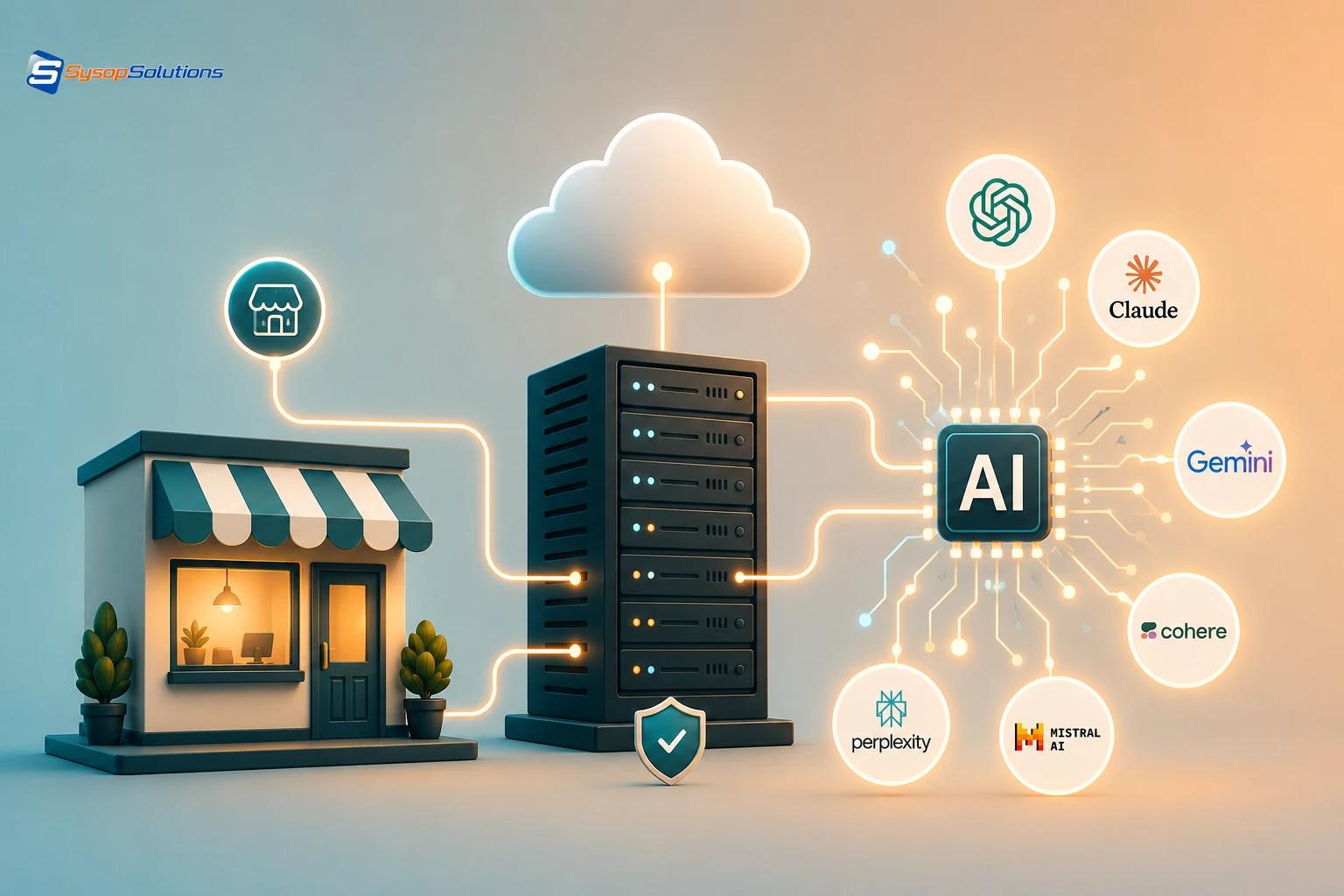
AI is changing how small businesses operate — but every chatbot, automation, and AI integration adds real load to your servers. Here's what that means for your infrastructure, and how Sysop Solutions helps you keep up.
Introduction
Two years ago, "AI for small business" mostly meant a chatbot widget bolted onto a website. Today it means AI writing code, running customer support, automating inventory decisions, and generating content — often running as background processes hitting your servers around the clock.
That shift matters more than most small business owners realize. AI tools aren't just software you log into anymore; they're workloads. They query your database, call your APIs, index your content, and process files — and every one of those actions runs on infrastructure somewhere. If that infrastructure isn't built to handle it, the tools that were supposed to save time end up creating new bottlenecks: slow response times, timeouts, and servers straining under loads they were never sized for.
This is the part of the AI conversation most small businesses skip — and the part that determines whether AI adoption actually pays off.
Overview: What "AI Transformation" Actually Looks Like for Small Businesses
For most small businesses, AI adoption isn't one big dramatic rollout. It's a series of smaller integrations stacking on top of each other over time:
A chatbot or AI support agent connected to the website and CRM
Automated content generation feeding directly into the CMS
AI-powered analytics dashboards pulling data continuously from live systems
Workflow automation tools (like n8n or Zapier-style pipelines) triggering AI calls on customer actions
Internal tools built on top of AI APIs for scheduling, invoicing, or reporting
Each of these looks simple from the outside. Underneath, each one adds recurring traffic, API calls, and processing load to servers that were often set up years before AI was part of the picture.
Key Benefits Small Businesses Are Seeing
Faster customer response times — AI-driven support handles routine questions instantly, day or night
Lower operating costs — automation reduces the manual hours spent on repetitive admin work
Better decision-making — AI-powered analytics surface patterns in sales, traffic, and customer behavior that used to require a data analyst
Content at scale — small teams can now produce marketing and support content that used to require a full content team
Personalization — AI enables product recommendations and tailored messaging that were previously only affordable for large companies
Common Problems Businesses Face When Adopting AI
Infrastructure that wasn't built for it. Many small business sites still run on shared or budget hosting plans sized for a static site — not for AI tools making continuous API calls, running background jobs, or serving larger file payloads.
Performance degradation. Adding AI chat widgets, automation pipelines, or AI-generated content workflows on top of an already-stretched server slows everything down, including the core website.
Security exposure. Every AI integration is another API key, another webhook, another point of access into your systems. Without proper server-side controls, that's a growing attack surface.
Maintenance complexity. AI tools update frequently, and keeping automation pipelines, self-hosted tools (like n8n or open-source AI agents), and integrations running reliably requires ongoing server management — not a one-time setup.
No one actually owns the infrastructure. In many small businesses, AI tools get added by whoever signed up for the free trial. Nobody is monitoring server load, uptime, or capacity as those tools scale.
Best Practices for Adopting AI Without Breaking Your Infrastructure
Size your server for workloads, not just traffic. AI automation adds background CPU and memory load even when nobody is visiting the site.
Isolate automation tools from your production site. Run workflow engines and AI agents on a separate VPS or container rather than the same server as your live website.
Monitor uptime and resource usage proactively. AI-driven traffic patterns are less predictable than typical human traffic.
Secure every API key and webhook. Treat each AI integration as a new access point that needs its own permissions and monitoring.
Keep self-hosted AI tools patched and updated. Tools like n8n, Ollama, or open-source agent frameworks need regular maintenance just like any other server software.
Plan for scale before you need it. If an AI-driven feature works well, usage grows fast — infrastructure should be ready to grow with it.
How Sysop Solutions Helps
This is exactly where Sysop Solutions comes in — the sysadmin's hosting company, built around hands-on server administration and infrastructure control rather than one-size-fits-all shared hosting.
As small businesses layer AI tools, chatbots, and automation pipelines onto their systems, they need infrastructure that can actually support that load — properly sized VPS environments, correctly configured Linux servers, and platforms like Coolify or cPanel/WHM managed by people who understand what's actually running on them. Sysop Solutions sets up and manages that foundation directly: right-sized VPS resources, isolated environments for automation tools, and the ongoing server administration that keeps everything running reliably as AI usage grows.
Real Business Benefits of Getting the Infrastructure Right
Reliable performance even as AI-driven traffic and automation load increase
Lower risk, with properly isolated and secured integrations instead of ad hoc API access
Room to scale, since infrastructure is sized for growth rather than reactive fixes
Fewer outages, because server capacity is monitored before it becomes a problem
Real cost savings, since a correctly sized VPS is cheaper than emergency upgrades after a slowdown or outage
Conclusion
AI is genuinely changing what small businesses can do with limited teams and budgets — faster support, smarter automation, and content production that used to be out of reach. But every one of those tools runs on infrastructure, and infrastructure that wasn't built for AI-driven workloads will eventually show it, usually at the worst possible time.
The businesses getting real value from AI aren't just adopting more tools — they're making sure the servers underneath can actually handle what those tools are doing.
Get Free Review
If your business is adding AI tools faster than your hosting was built for, Sysop Solutions can review your current setup and make sure your infrastructure can keep up.
Visit sysophost.com to get started.Still Few Queries...
Comments
No comments yet. Be the first to comment!