 Priya Nair
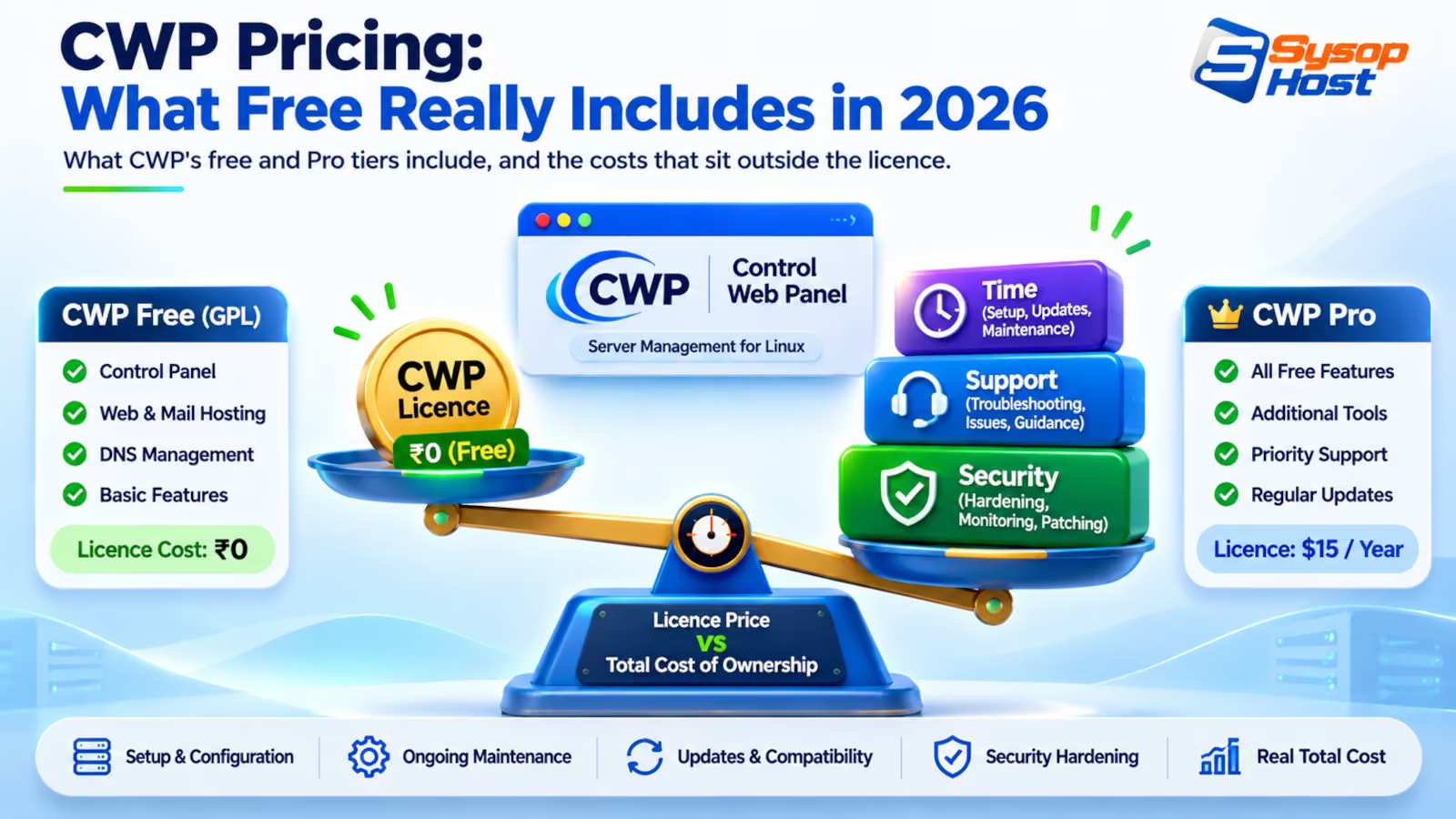
The CWP Pro license cost is only one line in the real bill. This guide separates the free edition from CWPpro, explains which features sit behind the paid tier, and adds the patching, support, security and exit costs that determine whether a cheap panel is actually cheap.
Control Web Panel is often recommended as "the free cPanel alternative". That is broadly true at the checkout, but it hides two questions that matter in practice: what the free edition actually includes, and what the rest of the bill looks like once a panel is running on an internet-facing server. Start with the CWP Pro license cost, then keep going until the bill reflects operations.
This guide separates licence facts from operational costs, flags where public figures disagree, and gives you a checklist for making the comparison honestly.
Key takeaways
CWP has a free edition limited to 10 accounts and a paid CWPpro tier at $1.49/month or $11.99/year. A support-inclusive tier is $12.99/month, and partner licences are $0.99 per licence per month for 10 or more.
cPanel's direct-store plans were quoted from about $29.99/month in late 2026, with per-account charges above higher tiers.
Some newer features — notably CWP Cage and lsPHP per domain — are CWPpro features. Cage is still labelled “coming soon” on the vendor's CWPpro page, so confirm availability in your build.
Observers note that CWP's site describes the core as free, not necessarily open source. Verify the licence text before relying on either description.
The licence is the smallest part of the real cost. Patching, backups, monitoring and support time dominate.
What the advertised tiers say
CWP's CWPpro page lists three tiers: CWP Free at $0, with up to 10 accounts and update checks every 24 hours; CWPpro at $1.49/month or $11.99/year, with all features unlocked, unlimited accounts and update checks every 4 hours; and CWPpro + Managed Support at $12.99/month or $142.89/year, which adds CWP Secure Kernel and support from CWP engineers. Partner licences are $0.99 per licence per month for hosting companies buying at least 10.
Those figures were verified on the vendor's CWPpro page on 18 November 2026. The 10-account limit is the detail most comparisons miss: a “free” panel is free for a small server, not for a reseller fleet. Packaging can still change — CWP shipped 14 releases in 2026 alone — so recheck the page before a purchase decision.
For context, cPanel's direct-store plans were quoted at $29.99/month for Solo Cloud, $35.99 for Admin Cloud, $53.99 for Pro Cloud and $69.99 for Premier, with additional per-account charges above the Premier account limit. A dedicated-server cPanel licence can cover up to 100 accounts on some tiers, which changes the comparison for larger hosts.
Free, open source, or neither?
This distinction matters more than it first appears. A "free" product may still be proprietary; an "open source" product may have paid add-ons.
GigeNET's 2026 comparison makes the point directly: CWP's site describes the core as free but does not say it is open source. Community descriptions calling it "open-source" are common, but the safer phrasing is free-to-use control panel with a paid Pro edition.
Why care?
Auditability. If you need to inspect or fork the code, "free" does not grant that.
Compliance. Some procurement policies require an open-source licence or a commercial support agreement. A panel that is neither clearly can stall approval.
Longevity. A commercial entity funding development is not a weakness; it is a fact to account for in continuity planning.
Before making a claim in a procurement document, read the current licence and support terms on the vendor's site, not a comparison article — including this one.
What moves behind the Pro licence
Public changelogs identify concrete features gated by CWPpro. The Edge channel's CWP Cage — per-account CPU, memory, process and I/O limits enforced with cgroups — is a CWPpro feature, as is lsPHP per domain in the PHP Selector. One inconsistency is worth knowing: the vendor's CWPpro page still labels Cage “coming soon”, while the Edge changelog describes it as shipping in 2.0.3. Confirm availability for the build you deploy. The migration page also warns when the destination server has no CWPpro licence, because migrated accounts' PHP-FPM sites will not work without it.
Other Pro-adjacent capabilities appear in vendor messaging: LSPHP, LSAPI-Cache, support services and a NOC partner programme. The exact bundle changes between releases, so list the features you actually need and confirm which tier provides them.
This is where "free" becomes a real decision. If you host multiple accounts and need resource isolation, the feature that matters most may be behind the paid tier — at a price still well below a cPanel licence.
The costs the licence does not show
A panel price covers software. Running it safely does not.
Patching labour. CWP had an unusually busy 2026: ten vulnerabilities disclosed in one November chain, two recovery-code CVEs shortly after, and a trojanized-binary campaign in between. The project responded with fast releases, but someone still has to apply them, verify the version and check for prior compromise. Version boundaries are messy — fixes landed across 1.12, 1.16, 1.29, 1.30.1 and 1.30.6.
Support and expertise. CWP's administrator interface may require more Linux knowledge than cPanel's structured WHM workflow. If your team is not comfortable with that, the saving can be spent on support hours or training.
Security infrastructure. Restricted panel ports, a VPN or allowlist, a reverse proxy or WAF for external request logs, file-integrity monitoring and off-host backups are all recommendations that follow from the 2026 incidents. Some are included in support plans; most still need configuration and supervision.
Migration and testing. Moving from cPanel involves DNS records, mail data, PHP versions and account mappings. Recent CWP releases fixed migration problems with TXT records and A/AAAA records pointing at the old server. A test migration is worth the time.
Downtime and reputation. For a host, a panel regression or security incident affects customers. That cost never appears in a licence comparison.
A total-cost worksheet
For each candidate panel, fill in:
Licence at expected account count — calculate at your real scale, not the entry tier.
Server cost — the panel does not change the VPS or dedicated-server bill.
Setup time — installation, hardening, migration and testing, priced at your team's rate.
Monthly maintenance — patching, backup verification, audits and support tickets.
Support arrangement — community, paid vendor SLA or internal on-call.
Security controls — WAF, monitoring, file-integrity tooling and incident response readiness.
Training and documentation — especially if staff know a different panel.
Exit cost — how hard it is to move off if the panel changes direction.
Compare the totals, not the headline numbers. On a single personal server, CWP's licence saving is decisive. On a server with 80 client accounts and no dedicated sysadmin, the calculation can invert.
Three cost scenarios, worked
Scenario A: one personal server, five sites. CWP free edition, no CWPpro. Licence cost zero; server cost is whatever the VPS costs. Main outlay is your own time to patch, restrict ports and verify backups. CWP wins clearly, provided you enjoy that work.
Scenario B: agency with 30 client sites on two servers. CWP free or Pro at a few dollars a month. The cost is now two sets of patching, monitoring and migration work, plus the support burden of an interface your team may know less well than cPanel. A modest CWPpro spend on isolation features may be justified; a full cPanel licence comparison depends on account tiers. The decision turns on staff time, not the panel price.
Scenario C: shared hosting reseller with 100+ accounts. cPanel's per-account isolation, WHM tooling, billing integrations and support become economically rational. CWP can technically host these accounts, but the operational and support savings of a mature ecosystem can outweigh a licence that is small relative to revenue. Run the numbers at your actual account count.
These are not verdicts about the software. They are reminders that "free" and "cheap" answer different questions from "suitable at this scale".
What support actually costs
CWP offers community support through its forum and Discord, with paid support services and a NOC partner programme. cPanel's licence includes a commercial support relationship, and many hosts value that when something breaks at midnight.
The question to ask is not whether support exists, but who answers when a panel upgrade breaks a customer's mail at 2 a.m. If the answer is "our sysadmin", price that person's time and on-call load into the comparison. If the answer is a vendor SLA, price the SLA. Both are legitimate; pretending the cost is zero is not.
The hidden exit costs
A panel that is cheap to enter can be expensive to leave. Check whether your configuration lives in the database, in plain files, or in a mix of both. Can you export accounts, DNS zones, mailboxes and SSL certificates in a usable format? Recent CWP releases improved account migration handling, but you should test an export before you need one.
Also consider data portability outside the panel: source code in Git, environment values in a secret store, backups in storage you control and DNS under your own account. Those habits cost little and reduce the risk that a licensing or project-direction change becomes a crisis.
How to compare on a single page
Put four columns on a sheet: licence at your scale, setup effort, monthly operations, and exit effort. Fill the licence column from vendor sources on the day you decide; fill the other three with hours and rates your team recognises. Most panels look very different once the last three columns are populated, and the one that "costs nothing" is rarely the cheapest operationally.
Share the sheet with whoever owns the pager. Their estimate of monthly operations will be more realistic than yours.
What to verify before you decide
Current CWP free and Pro pricing from the vendor directly
Exact features included in each tier at the version you will deploy
Licence and support terms in writing
Whether required features (for example Cage) need Pro
cPanel pricing at your account count, not the entry plan
Team familiarity with the admin interface
Patch process and named owner
Security controls budgeted and configured
Migration and restore tested on a staging server
A final warning about stale comparisons
Most "best free control panel" articles are written once and rarely updated. Prices change, features move between tiers and security postures shift — CWP alone shipped more than a dozen releases in 2026. Use comparisons to build your shortlist, then verify every number and feature that affects your decision on the vendor's own site. That applies to this article too.
The bottom line
CWP is genuinely low-cost, and for a capable administrator on one or two EL servers it can be excellent value. Remember that the free edition stops at 10 accounts; beyond that, CWPpro is the real entry price. "Free" describes the licence, not the operation. Add patching, hardening, backups and support to the comparison, and the right answer becomes obvious for your situation rather than for a generic blog poll.
Price the whole server, not just the panel
SysopHost provides hosting with managed patching, backups and monitoring so the licence is only one line in a predictable bill.
Review Hosting PlansComments
No comments yet. Be the first to comment!