 Neha Sharma
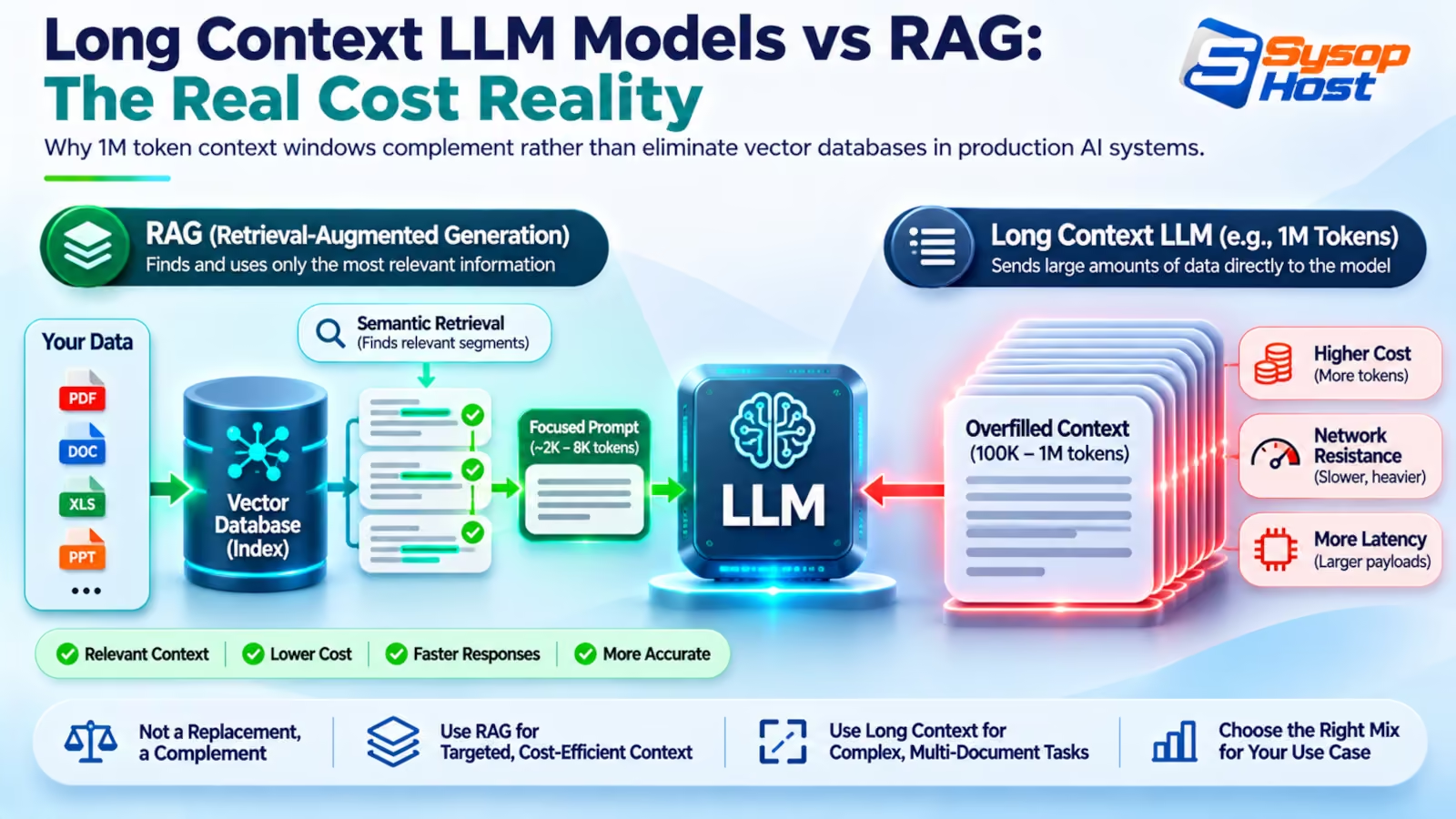
Marketing promises that million-token context windows make Retrieval-Augmented Generation obsolete collapse when production invoices arrive. Pushing twenty PDF manuals into every prompt generates thirty-second first-token latencies and drains monthly cloud budgets. Review the engineering balance between vector indexes and long context windows.
When frontier AI laboratories announced models capable of ingesting one million, two million, and even ten million tokens in a single request, engineering forums filled with declarations that vector databases were dead. Why bother chunking documents, calculating embeddings, and tuning semantic search pipelines when you can simply upload your entire technical documentation library into the prompt?
The answer arrives with the first monthly billing cycle. Long context llm models without a retrieval filter turn inference into an expensive, high-latency brute-force search.
While expanding context windows solve genuine architectural pain points (such as analyzing multi-file codebases, legal contracts, and lengthy transaction logs), context isn't free. Squeezing hundreds of pages of unindexed text into every API call creates severe Time to First Token (TTFT) delays, triggers cognitive degradation in the middle of prompts, and burns cloud capital that could be preserved with a basic retrieval pipeline.
The million-token promise versus production economics
To understand why unconstrained context stuffing fails in production, look at the arithmetic of commercial token billing.
Suppose an enterprise legal platform assists attorneys with contract review. The team manages a repository of 200 standard contracts, representing roughly 800,000 words or approximately one million tokens.
Consider two contrasting design patterns:
Pattern A (Naive Context Stuffing): Every time an attorney asks a question ("What are the indemnification terms in the 2024 Acme agreement?"), the backend sends the entire 1,000,000-token contract repository in the prompt.
Pattern B (Targeted RAG Pipeline): The platform uses an embedding index to locate the three most relevant contract sections (approximately 4,000 tokens) and passes only those excerpts to the model.
Operational Dimension | Pattern A: 1M Token Context Stuffing | Pattern B: Hybrid RAG (4K Excerpt) | Production Impact |
|---|---|---|---|
Input Cost Per Query (Standard) | $2.50 to $5.00 per request | $0.01 per request | Pattern A is 250x to 500x more expensive per interaction. |
Input Cost (With Prompt Caching) | $0.50 to $1.25 per request | $0.005 per request | Caching helps, but Pattern A still costs 100x more. |
Time to First Token (TTFT) | 15 to 45 seconds | 600 to 1,200 milliseconds | Users wait half a minute before the first word renders. |
Hardware / VRAM Requirement | Massive (Multiple 80GB H100s for KV cache) | Modest (Single 24GB GPU or basic API) | Self-hosting 1M context demands high cluster capital. |
10,000 Queries Monthly Budget | $25,000 to $50,000 | $100 to $150 | Context stuffing introduces financial instability. |
Even with aggressive provider prompt caching, sending a million tokens twenty times an hour burns hundreds of dollars a day on queries that could be answered using fifty cents of compute.
The quadratic attention tax: TTFT latency degradation
The second barrier is physical, and it's latency. In standard transformer architectures, the attention mechanism scales with the square of the context length ($O(N^2)$), or at best linearly ($O(N)$) using FlashAttention and specialized ring-attention kernels [1].
Before an LLM can emit its first completion token, it must execute the prefill phase. The model processes every input token in the prompt to construct the initial Key-Value (KV) cache.
For a prompt containing one million tokens:
Pre-fill computation consumes seconds of raw GPU cycles: Prefill runs at roughly 20k to 60k tokens per second per GPU on current hardware, so a million tokens is 15 to 45 seconds of solid matrix multiplication before the first output token. Run the division for your own GPU rather than trusting a vendor's marketing number.
Interactive sessions stall: A human user waiting 30 seconds for an interactive query assumes the application has failed.
KV cache memory exhaustion: Storing the active attention state for a million tokens requires 10 GB to 30 GB of pure VRAM per concurrent request, depending on model size and quantization. If five users submit queries simultaneously, the serving cluster exhausts GPU memory and drops incoming connections.
When operating on managed cloud infrastructure, absorbing these latency spikes requires expensive over-provisioning that yields poor utilization during off-peak hours.
Retrieval accuracy: the needle-in-a-haystack reality
Proponents of context stuffing often cite synthetic benchmark scores, such as the "Needle In A Haystack" (NIAH) test, where a model successfully retrieves a single arbitrary sentence planted inside a 500,000-token prompt.
Synthetic benchmarks don't reflect enterprise reality. In a standard NIAH test, the target sentence is unique and irrelevant to the surrounding text ("The secret password for the security gate is BlueApple42"). The attention mechanism locates this anomaly with high statistical contrast.
In real-world business scenarios, the context contains hundreds of competing, semantically similar statements:
Twenty different contracts contain indemnification clauses with slightly varying liability caps ($1M versus $5M versus uncapped).
System logs contain hundreds of similar timeout errors occurring across different microservices.
Financial filings discuss revenue under multiple accounting revisions across different quarters.
When confronted with high semantic overlap across 500K+ tokens, models suffer from the "lost in the middle" phenomenon [2]. Accuracy peaks at the very beginning and very end of the prompt context, while information buried in the middle 60% of the document suffers from higher retrieval failure rates.
A structured RAG pipeline extracts the exact relevant clauses and places them directly into the primary attention window, eliminating semantic confusion.
The financial breakdown: 1M context versus vector search
The usual counterargument is that vector databases and embedding pipelines aren't free to run. Fair enough. The numbers are below.
Running a production-ready vector search pipeline requires:
Vector Database / Extension: PostgreSQL with the
pgvectorextension running on an NVMe cloud instance ($60 to $180/month).Embedding Ingestion Pipeline: Generating embeddings using an open-weight model (like BAAI/bge or nomic-embed) running on a small CPU worker ($40/month) or via batch API ($10 one-time per 100,000 documents).
Chunking and Ingestion Code: A standard service utilizing LangChain, LlamaIndex, or native SQL queries.
Total fixed monthly expense for the vector pipeline: approximately $120 to $250.
Now compare that against query-time token costs:
Monthly RAG Savings=(Queries×Cost per 1M Context Query)−(Queries×Cost per RAG Query+Vector DB Hosting)
If your team runs just 500 document queries a month:
1M Context Cost=500×$3.00=$1,500
RAG Cost=(500×$0.01)+$150=$155
The basic vector pipeline saves $1,345 every month on light usage. On heavier workloads, the savings exceed tens of thousands of dollars. Coordinating these infrastructure decisions through structured FinOps solutions prevents teams from falling into deceptive compute traps.
The hybrid pattern: vector retrieval with wide context verification
The pragmatic answer to the "RAG versus Long Context" debate is not to choose between them, but to combine their strengths.
Use vector retrieval for coarse candidate selection, and use the wide context window for deep document synthesis.
User Query: "Analyze how liability terms evolved across our 2024 vendor agreements."
                                │
                                ▼
┌────────────────────────────────────────────────────────────────────────┐
│ Stage 1: Coarse Vector Retrieval (Fast / Cheap)                        │
│ - Scan 10,000 agreements using pgvector metadata filtering             │
│ - Select top 12 relevant full contracts (~60,000 tokens)               │
└────────────────────────────────────────────────────────────────────────┘
                                │
                                ▼
┌────────────────────────────────────────────────────────────────────────┐
│ Stage 2: Deep Context Synthesis (Comprehensive Reasoning)              │
│ - Feed 60,000 tokens into a long-context model in a single prompt      │
│ - Model performs cross-document reconciliation and identifies changes  │
└────────────────────────────────────────────────────────────────────────┘
                                │
                                ▼
Response: "Between Q1 and Q3, liability caps shifted from uncapped to..."
Why this hybrid pattern succeeds
Eliminates Chunk Fragmentation: Classic RAG suffered when answers required synthesizing data scattered across twelve different paragraphs. Splitting documents into 500-token chunks destroyed cross-document context.
Preserves Low Latency: Feeding 60,000 tokens instead of 1,000,000 tokens reduces TTFT from 30 seconds down to two seconds.
Controls Token Expenses: Slicing 95% of irrelevant text out of the prompt protects your API budget while still granting the model sufficient breadth to reason across complete chapters.
For organizations running multi-tenant Kubernetes workloads, hosting these hybrid retrieval pipelines on reliable cloud hosting or dedicated instances guarantees consistent database I/O for embedding queries.
Practical caching configurations to control input costs
When large context inputs are unavoidable, configuring prompt caching correctly is essential.
Major model providers now cache static prompt prefixes. If consecutive requests share an identical opening block of tokens (typically requiring a minimum threshold of 1,024 or 2,048 tokens), the server reuses the pre-calculated KV cache rather than recomputing attention from scratch [3].
Follow these architectural rules to ensure cache hits:
# Optimal prompt layout for maximum cache utilization:
messages = [
    # 1. Static System Instructions (Cached: Reused across all users)
    {"role": "system", "content": STATIC_SYSTEM_PROMPT},

    # 2. Static Knowledge Base / Base Document (Cached: Reused across queries)
    {"role": "user", "content": f"Reference Documentation:\n{STATIC_POLICY_DOCS}"},

    # 3. Dynamic User Query (Uncached: Placed at the very end)
    {"role": "user", "content": f"User Question: {user_input}"}
]
Never inject dynamic timestamps into the system prompt: Adding current timestamps or random session IDs at the beginning of the prompt invalidates the cache prefix for every subsequent token.
Keep large reference manuals immutable: Place fixed technical manuals or code repositories immediately after the system prompt.
Append dynamic user variables last: The user's specific query should always reside at the absolute end of the input sequence.
Adhering to this structure delivers cache hit ratios exceeding 90% on repetitive document review systems. If you run self-hosted clusters on Kubernetes, pairing these strategies with Kubernetes consulting services ensures your ingress controllers maintain sticky sessions to keep local GPU KV caches warm.
Architect cost-effective AI infrastructure that scales
SysopHost provides high-performance cloud VPS, dedicated NVMe storage, and expert DevOps engineering to deploy vector search pipelines, private models, and low-latency API gateways.
Explore Cloud InfrastructureComments
No comments yet. Be the first to comment!