 Rohan Verma
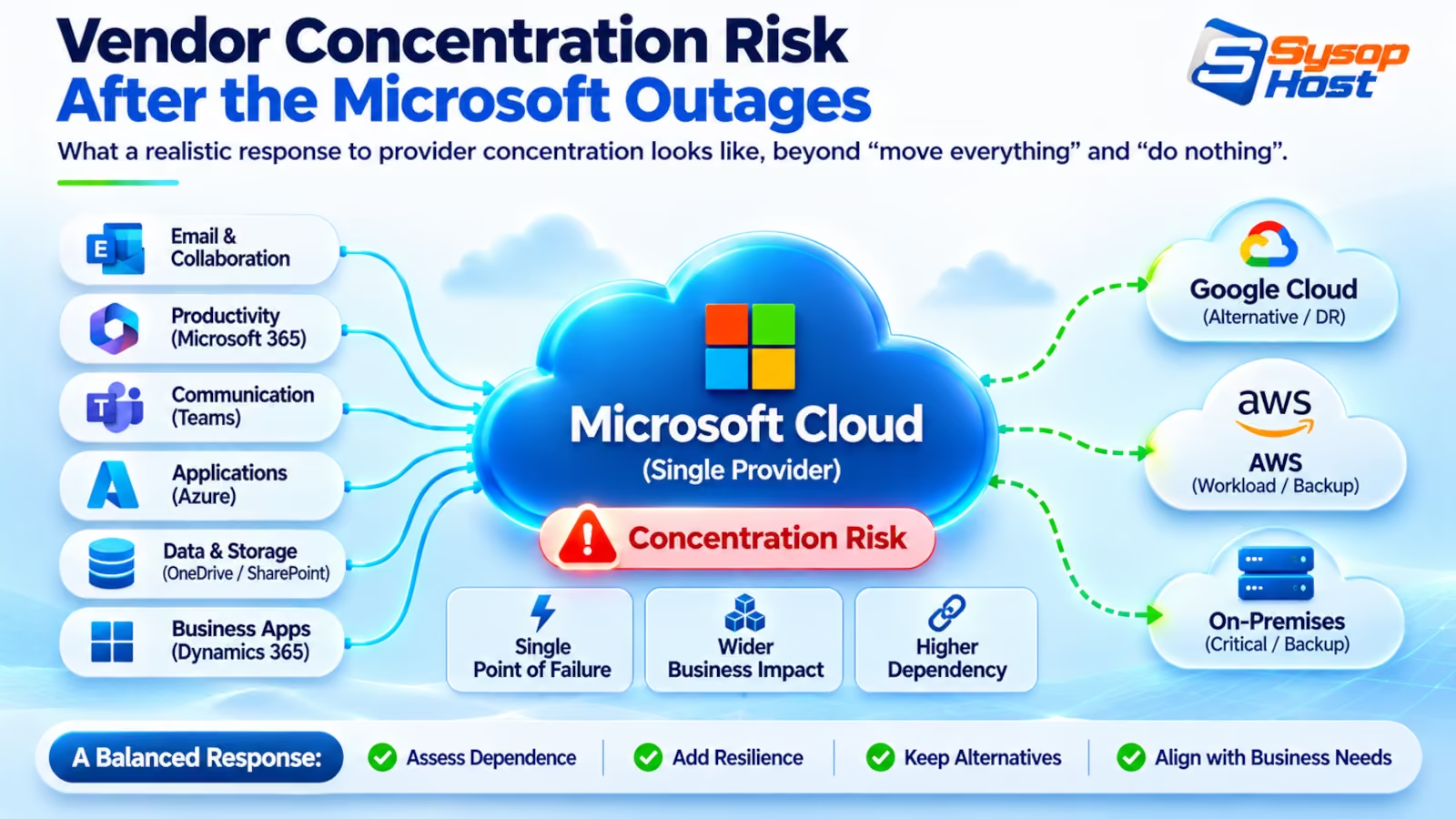
The November 2026 Microsoft outage raised a broader question about vendor concentration risk: how many business processes fail together when one provider does. This analysis separates realistic continuity measures from the false comfort of a second cloud account, and sets out what to test.
For most of a working day in November 2026, a large share of the world's email, calendars and AI assistants stopped working. The cause was not a cyberattack and not an AI agent. It was a technical fault inside Microsoft's cloud infrastructure, and it showed how much of modern business depends on a very small number of providers. The Microsoft outage vendor concentration risk conversation is really about shared failure domains.
The event prompted a familiar argument. One camp says organisations must diversify or accept existential risk. Another says switching costs are so high that diversification is theatre. Both are partly right, and both are incomplete. The useful question is not "should we leave Microsoft?" but "what happens to our business when any single provider has a bad day?"
Key takeaways
The November outage affected 19 Microsoft 365 services through a shared dependency on Exchange Online, plus consumer Outlook.com and Hotmail.
Microsoft's preliminary report describes a dormant defect in networking gateway servers combined with capacity loss, traffic shifts and automated failover — the failover mechanism spread the failure to roughly 80% of the gateway fleet.
It was the third major Microsoft cloud failure in four months, following an August Microsoft 365 outage and an October Azure incident.
Classic disaster planning advice — "run a second service" — is hard to execute when email and identity are embedded in daily work.
The realistic middle path is graceful degradation: keep critical processes running with reduced capability, and test that plan.
What happened, briefly
Impact began at 10:05 UTC on 12 November and ended at 16:10 UTC on 13 November, with full restoration announced early on 14 November — about 23 hours and 50 minutes of customer impact. Reports came from more than 70 countries, and Downdetector logged over 7.4 million reports globally with a peak near 20,000 per minute.
Microsoft's preliminary post-incident report, released on 16 November, attributed the failure to a software defect introduced in July 2026 in Microsoft 365 networking gateway servers. Testing environments ran mostly older hardware, while the defect appeared on newer, higher-core-count servers under specific workloads. Then two other conditions converged: Teams traffic had recently been redirected onto the same gateways, and an unrelated issue had reduced available server capacity. Automated traffic redirection, designed to preserve availability, pushed traffic onto healthy servers where the same defect then triggered.
That combination explains both the breadth and the slow recovery. A simple rollback was not possible; engineers had to take groups of servers offline, apply a fix, restart them and return capacity gradually. Microsoft said the incident was not caused by malicious activity or an AI agent. A final report was still pending at the time of writing.
What "concentration risk" actually means
Concentration is not just "we buy from one vendor." It is the number of business processes that fail together when one dependency fails.
The November incident showed three layers of it:
Service concentration. Exchange Online is the shared dependency. Microsoft's status page said features interacting with Exchange Online were affected while elements that did not depend on it kept working — which is why core Teams chat and meetings largely survived while calendars, scheduling and Copilot's work information did not.
Ecosystem concentration. Third-party tools connected to Outlook calendars failed too, and OpenAI and Anthropic reported problems with their Microsoft 365 connectors. A provider outage propagates through integrations you did not build.
Institutional concentration. Computer Weekly's data found 46 of 48 UK police forces route email through Microsoft 365, and 132 of 213 NHS trusts route email and identity through it. The same pattern appears in governments, courts, hospitals and transport systems worldwide.
The risk is not that a provider is evil or incompetent. It is that efficiency drives many independent organisations onto the same failure domain.
Why the standard advice is hard to follow
"Use a second provider for resilience" sounds sensible. In practice, email and collaboration tools are deeply embedded. Matt Saunders of Adaptavist told the BBC that classic disaster planning suggests a second service, but in practice it is almost impossible for a business to function without tools like Microsoft.
Reuters quoted analysts making the opposite point: repeated incidents may give IT departments a reason to think twice, but switching costs remain steep because the tools are woven into daily operations. Both observations are correct. A full duplicate of Microsoft 365 for a mid-sized organisation is usually unaffordable, and a partial duplicate that nobody has tested is worse than none.
This is where the conversation often stalls. Leaders conclude that nothing can be done until a migration budget appears. That is the wrong conclusion.
Three realistic levels of response
Level | What it means | When it fits |
|---|---|---|
Accept and degrade | Keep the provider, define which processes continue at reduced capability, and communicate clearly during an incident | Most organisations, initially |
Partial diversification | Backup communications channel, exported contacts, out-of-band identity, hosted email fallback for critical correspondence, tested data exports | Organisations with real continuity requirements |
Full migration | Replace core suite with an alternative stack | Rare; justified only where regulatory or sovereignty needs dominate |
Level one is not surrender. Graceful degradation means deciding in advance that sales can still take orders by phone, that critical approvals can be recorded on paper or in a separate system, and that staff know where to send an urgent message when mail is down. During the November incident, a winemaker in South Africa described his export communications halting and production work stopping because day-to-day operations relied on those systems. That is a process-design failure as much as a cloud failure.
Level two is where most useful investment sits. A backup channel agreed with your team and main clients before it is needed costs little. Exporting key contacts outside Outlook costs little. Keeping a break-glass administrative account that does not depend on the same identity path can be decisive. Ensuring you can retrieve your data in a usable format is a genuine hedge against both outages and commercial changes.
Level three should be treated as a strategic decision with a long horizon, not an emotional reaction to a bad week. The Swiss government's trial of an open-source alternative reflects sovereignty and resilience goals that most private businesses do not share.
What to test, not assume
A continuity plan that exists only as a document will fail during a real incident. Test these specifically:
Can staff communicate without email? Agree a channel, publish it, and run a short exercise.
Can you reach key contacts? Export them from Outlook into a portable format and confirm the file is accessible without Microsoft 365.
Can you sign in from another device? During an outage you may need a different machine. Confirm passwords and second-factor methods are reachable.
Are critical records available locally? Cached Exchange Mode helps, but it does not help on a machine that was never set up for it.
Do you know how to read the provider's status? Service health, the public status page and alert notifications need to be configured on a quiet day.
Can you get your data out? Test an export from the tenant to storage you control.
Notice that none of these require a second email platform. They reduce the blast radius of the one you have.
Questions to ask any provider
This discipline applies to Google, AWS, your hosting provider and your Microsoft reseller, not just Microsoft.
Which services share a common dependency? Where is the single point of failure?
What is the published uptime commitment, and what is the actual measured availability over the last year?
How are incidents communicated, and can alerts be sent to an address outside your own tenant?
When is a preliminary post-incident report published, and when is the final one?
What data can you export, in what format, and how quickly?
Which parts of the service run on your own infrastructure rather than a third party's?
Microsoft's own published worldwide uptime table is a useful reminder that availability is measurable and variable: 99.526% in Q1 2026 and 99.994% in Q2 2026, according to its service health documentation. A percentage is not a promise about any particular day.
The board-level framing
Executives do not need the gateway architecture. They need three numbers and a decision. What proportion of revenue-generating processes depend on one provider? How long can those processes run at reduced capability? What would we spend to extend that time?
Analyst estimates can help size the stakes but should be labelled as estimates. Morningstar DBRS put global insured losses from the November incident at $300–500 million, below the estimated toll of the 2024 CrowdStrike outage. That figure says something about the scale of dependencies; it says nothing about your own exposure.
The right board decision is usually to fund degradation and testing, not a wholesale migration. That is a smaller, faster and more honest response to concentration risk.
What not to conclude
"Microsoft is unreliable, so we must leave." Switching costs are real, and a rushed migration introduces its own risks.
"It was one bad day, nothing to change." It was the third major Microsoft cloud failure in four months.
"Multi-cloud solves this." Running workloads across providers does not help if identity, email and collaboration still sit in one tenant.
"Service credits make us whole." Credits are a contractual remedy, not continuity. They do not restore lost orders or missed appointments.
A practical checklist
Map which business processes stop when email and calendars stop
Rank those processes by business impact
Define a reduced-capability procedure for the top three
Agree an out-of-band communication channel with teams and key clients
Export contacts and critical records to storage you control
Configure provider alerts to an address outside the affected tenant
Test sign-in and access from a second device
Schedule a short outage exercise and record what failed
Review the provider's post-incident reports when published
The bottom line
Vendor concentration is a design choice, usually made gradually for good reasons. You do not have to undo it to manage it. Decide what still works when the provider does not, test that decision, and keep a credible path to your own data. That is a far more useful response than waiting for the next outage to tell you how dependent you are.
Plan for the day a provider has a bad one
SysopHost helps businesses map critical dependencies, host fallback services and test continuity plans before an outage makes the decisions for them.
Discuss Continuity PlanningComments
No comments yet. Be the first to comment!