 Rohan Verma
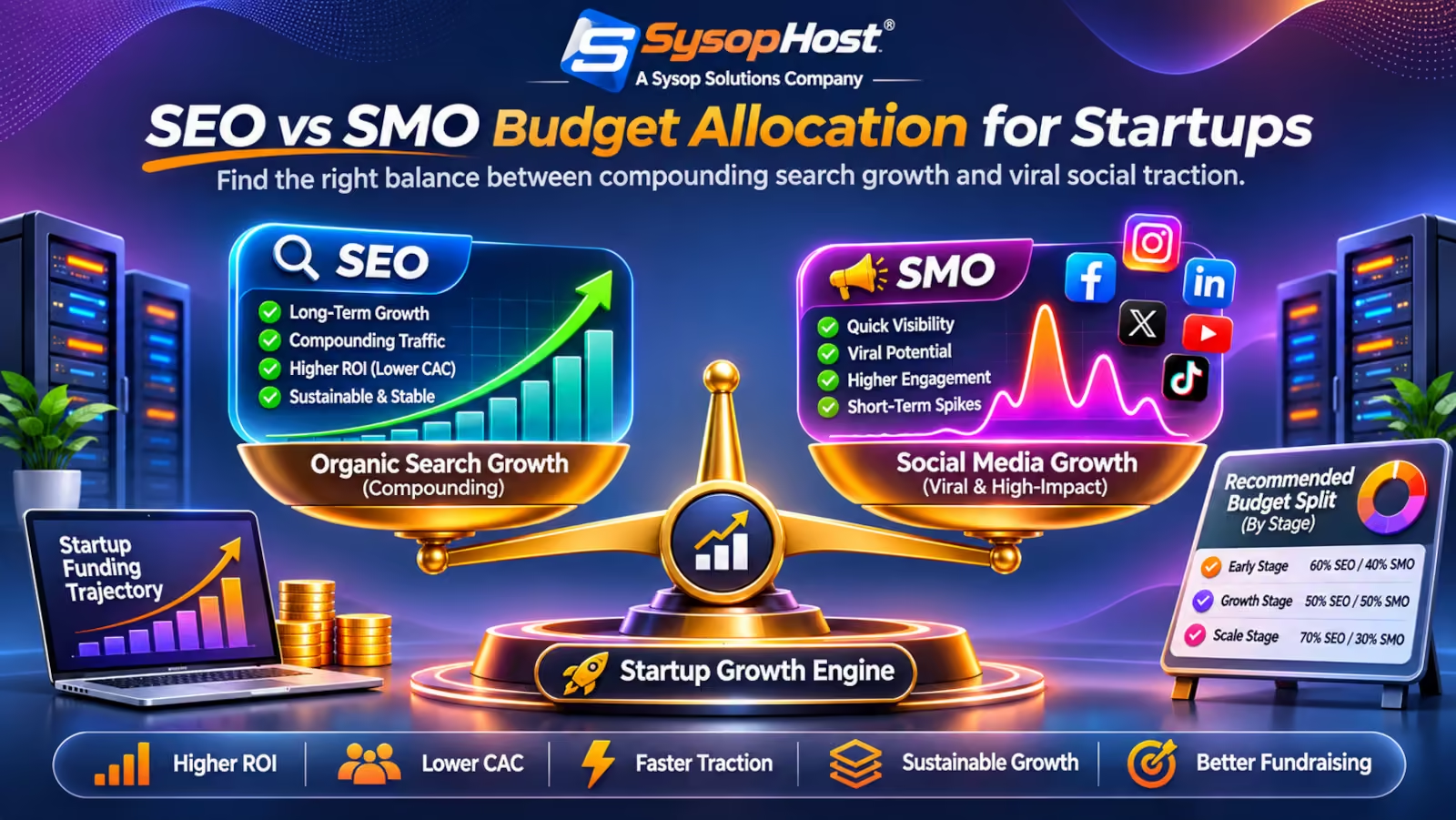
Search and social fail on different clocks, so the split is a runway decision before it is a marketing one. This is the model, the assumptions behind it, the arithmetic on a real $8,000 month, and the hosting line that eats both halves.
A seed-stage team has $8,000 a month for marketing and one person who can write. The founder spends Sunday on LinkedIn. A freelancer files two blog posts a month. Neither line has a number attached to it, so the Tuesday review turns into an argument about effort.
Getting the SEO vs SMO budget allocation right is what ends that argument, because the two channels are different financial instruments and they fail on different clocks. One is a capital asset with a lag of months. The other is working capital that expires in days. The question is not which channel to pick. It is how much you can fund before either one pays you back.
One warning before the ratios. Everything numeric below is a planning input, not a benchmark. Nobody has seen your pipeline, your sales cycle or your category's search demand, and no published survey will either. Replace each assumption with your own number and the model still works.
What you are actually buying
Search buys a page that keeps earning after you stop working on it. The cost is front-loaded: research, writing, technical setup, and months of nothing much. Social buys attention today. The cost is perpetual, because the feed resets every morning and yesterday's post is worth nothing.
Search (SEO) | Social (SMO) | What it means for a small budget | |
|---|---|---|---|
Time to a qualified lead | Months. Plan for the long end in a crowded category | Days to weeks | Social funds the quarter; search funds next year |
Cost curve | Expensive early, near zero marginal cost later | Roughly linear, and it rises as feeds fill up | Search gets cheaper per lead only if you keep publishing |
What decays | Rankings drift without maintenance | The post is gone by Thursday | Budget for upkeep, not just creation |
What you can measure | Queries, impressions, assisted conversions | Referrals, branded search lift, comments | Neither channel reports itself honestly without a second signal |
Failure mode | You run out of runway first | You build no asset and hire a content treadmill | The split exists to avoid both |
The stage split, as a model
The SEO vs SMO budget allocation below is a model with stated assumptions, not a research finding. It assumes four things: no meaningful paid budget, one or two people who can both write and edit, a category where buyers search before they buy, and a runway figure you can compute without guessing.
Stage | Runway | Split | What the social spend buys | What the search spend buys | Move on when |
|---|---|---|---|---|---|
Validate | Under 12 months | 70% SMO / 30% SEO | Message testing, community answers, first ten customers | Crawlable site, clean commercial pages, Search Console | Two consecutive months of the same pitch surviving contact with buyers |
Grow | 12 to 24 months | 50% SMO / 50% SEO | Distribution of the same research, founder voice, video | Comparison pages, one deep piece per month, first links | Organic starts producing leads you did not chase |
Scale | Over 24 months, or profitable | 70% SEO / 30% SMO | Amplification and reputation, not acquisition | Top and middle of funnel, programmatic pages, schema | Search cost per lead is lower than social, and stable |
Validation leans on social because your message is still moving. Writing twelve SEO pages for a positioning you abandon in March is the most expensive mistake in this article, and it is common. Early content also has nowhere to rank: a new domain with no links and no branded demand takes months to be trusted, and by then the product has changed.
Scale leans on search because the marginal cost of one more visitor falls toward zero while the marginal cost of one more social impression does not. That is arithmetic, not strategy.
A worked example, with the arithmetic visible
Take the $8,000 month and subtract the fixed costs first, because they are not optional and they are not marketing.
Hosting that can serve a campaign without falling over, analytics, a rank tracker, and a scheduling tool come out of the envelope before anything else. Use your own invoices; a hosting line is usually the smallest of the four and the one that breaks the campaign when it is wrong.
Say $600 goes to tooling and infrastructure, leaving $7,400 of variable spend. At the validation split that is $5,180 for social and $2,220 for search. The social money is mostly time: answering threads properly, recording a three-minute explainer, writing a post that takes a position. The search money buys roughly one serious piece and the technical work around it, which is why most seed teams should buy depth rather than volume.
The ratio matters less than the review. If the social half produces eight conversations with real buyers in a month, the split is working. If it produces likes from other founders, it is not, and moving to 50/50 will not fix it.
The line item that eats both budgets
A page that takes two seconds to start answering has already lost the visitor you paid for. Time to first byte measures how long the server takes before it sends anything, and no front-end work recovers that gap [1]. For a visitor arriving from an in-app browser on a congested mobile connection, that first byte is most of the perceived wait.
$8,000 of acquisition spend
        │
        ▼
[ server answers in 2.0s ] ──► visitor stares at white space
        │
        ▼
[ server answers in 300ms ] ──► visitor sees the offer
The Core Web Vitals thresholds are the numbers your pages are measured against: LCP within 2.5 seconds, INP at 200 milliseconds or less [2]. Google is also explicit that good scores do not guarantee rankings, and that there is no single page experience signal [3]. So do not sell speed to yourself as a ranking play. Sell it as a conversion play: you already bought the click, and a slow server throws part of it away.
That is the argument for moving a campaign landing page off an overloaded shared account and onto infrastructure you control, and the mechanics are in why website speed matters for SEO. The same discipline that keeps a cloud bill honest applies here, which is why the hosting question belongs with FinOps rather than with the design budget.
What the ratio cannot tell you
Three things sit outside the model, and all three can override it.
The first is pivot risk. A pre-product-market-fit company should not buy assets that assume today's positioning, and no ratio fixes that. Content written for a customer segment you abandon is a sunk cost with a URL.
The second is category demand. If nobody searches for your problem, search has no floor to stand on, and the honest allocation is close to all social. Check before you budget: type your three best commercial phrases into Google and see whether the results are vendors or blog posts.
The third is paid. Organic social and paid social are different line items with different maths, and a ratio that mixes them hides the one number a founder needs, which is what a customer costs.
Reviewing the split every quarter
Four habits keep the ratio honest.
Put one number on each channel and defend it. For search, that is qualified leads from organic, not sessions. For social, it is branded search impressions plus conversations that reached a call, not followers.
Use a long enough window. Measuring social on last-click revenue makes it look worthless, because most of its value arrives later as a branded query. Thirty days is short. Ninety is defensible.
Watch for the AI-answer effect in reporting rather than guessing at it. Traffic from AI features shows up inside the ordinary Search Console performance report instead of a separate bucket [4], so a flat line can hide a shift in where the click came from.
Change the ratio on evidence, not on a bad month. If the search half has produced nothing after two publishing cycles, the content is wrong, not the split. If social produces conversations but they never convert, the offer is wrong. Neither is a budget problem.
If you would rather have the campaign side run by someone else, that is what digital marketing covers. For the infrastructure half, cloud hosting is the piece that decides whether the click survives.
Is your server eating the budget you spent on the click?
Managed cloud hosting with 99.99% uptime and 24/7 engineer support, for the weeks a campaign outperforms the plan.
See cloud hosting plansComments
No comments yet. Be the first to comment!