 Rohan Verma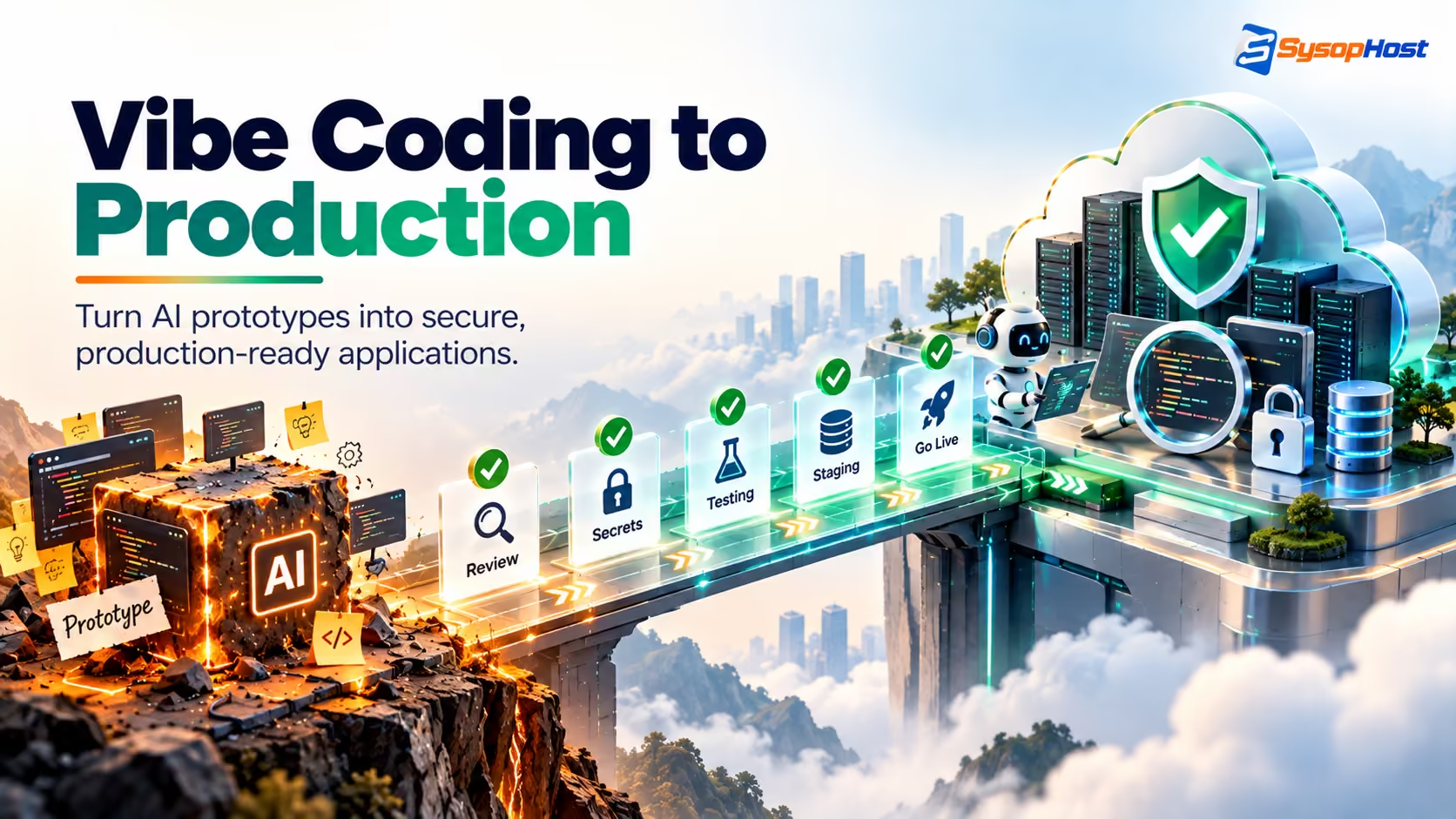
Your AI-built prototype works on demo day — but production is a different game. Here is the small-team playbook for closing the gap: the review layers, secret hygiene, and release discipline that turn a fast demo into something strangers can safely trust with their data.
The demo worked. The agent scaffolded the app in an afternoon, the buttons click, the data saves, and the founder is already sharing the link. Then someone asks the uncomfortable questions: where are the API keys stored, what happens when two users edit the same record, who reviewed the authentication code — and the room goes quiet. The distance from vibe coding to production is everything that sits between that demo and real users.
Vibe coding — describing software in natural language and letting AI agents write it — has collapsed the cost of a working prototype to near zero. What it has not collapsed is the cost of production: security, reliability, data integrity, and operability. The gap between "it runs on my machine" and "strangers trust it with their data" is where vibe-coded apps die, get breached, or quietly rot.
This guide is the bridge. It is written for the small teams and founders who built with AI speed and now need production discipline — the minimum guardrails that make an AI-built app shippable without hiring a platform team.
Quick answer: Treat every AI-written change as an unreviewed draft until proven otherwise. Put it through five layers: a written change contract, a sandboxed execution boundary, code review plus revision-bound release evidence, regression review of business behavior, and a named human approval. Underneath that, enforce the non-negotiables: secrets server-side, real authentication, automated tests on critical paths, CI/CD scanning, a staging environment, backups, and observability from day one.
Key takeaways:
AI-generated code fails security at alarming rates in formal studies — assume draft quality, not senior-engineer quality.
Hardcoded secrets are the #1 recurring flaw in AI-built apps. Fix that first; it takes an afternoon.
Five review layers (contract, boundary, review + evidence, regression, approval) catch what any single check misses.
A staging environment plus CI scanning is the cheapest production insurance a small team can buy.
Make the secure path the easy path: templates, golden paths, and managed hosting beat policies nobody follows.
Know when to harden versus rewrite — not every prototype deserves to become the foundation.
Why AI-built apps break in production
Understanding the failure modes tells you which guardrails matter. The research is sobering.
Security defects are the norm, not the exception. A formal verification study of 3,500 AI-generated code artifacts across seven leading models (April 2026) found vulnerability rates no model escaped — the best performer still failed nearly half the security-critical prompts, and SQL injection tests produced working exploits including data exfiltration. Models even flag flaws in review mode that they themselves generate in write mode. The lesson: an agent that writes plausible code is not an agent that writes safe code.
"Almost right" is the defining complaint. Stack Overflow's Developer Survey found two-thirds of developers frustrated by AI output that is "almost right, but not quite" — and 45% say debugging AI-generated code is more time-consuming. Subtle wrongness — an off-by-one in a billing calculation, a permission check that covers the happy path but not the edge case — is exactly what slips through demos and explodes in production.
Dependencies arrive unvetted. Agents pull in open-source packages at machine speed, often without risk review. In August 2026, the ChainDrop worm compromised 400+ npm packages downloaded hundreds of millions of times weekly, propagating to new packages within minutes. An agent happily npm installs whatever solves the immediate problem; governance has to come from your pipeline, not the agent's judgment.
No memory of your business rules. The agent does not know that refunds over $500 need manager approval, that patient data cannot leave the region, or that the legacy export format must stay byte-compatible. Regression — breaking established behavior while adding the new thing — is the silent killer of AI-driven development.
None of this means vibe coding is a toy. It means the prototype is step one of five, and steps two through five are guardrails.
The five-layer guardrail system
Practitioner frameworks for production agent workflows converge on five distinct controls. Each answers a different question, and skipping any one leaves a hole the others cannot cover.
Layer | Control | Question it answers |
|---|---|---|
1 | Change contract | What may change, and what must remain stable? |
2 | Execution boundary | What may the agent access and do? |
3 | Code review + release evidence | Is the changed code correct — and what proves this exact revision is ready? |
4 | Regression review | What established business behavior could break? |
5 | Accountable approval | Who accepts the remaining uncertainty? |
Layer 1 — Change contract. Before the agent touches anything, write down scope in plain language: what is in scope, what must remain stable (existing permissions, audit history, data formats), and how failures must behave (expired tokens return a defined error without creating records). A contract turns "make invitations work" into a verifiable task and gives reviewers something to check against besides vibes.
Layer 2 — Execution boundary. Sandbox the agent by default: limit writes to the approved repo area, deny network access except named destinations, keep production credentials and deploy authority outside the agent environment, use short-lived scoped credentials where auth is needed, and treat everything the agent reads (issues, logs, web pages) as untrusted input. Log tool calls and outcomes. Note the anti-pattern: blanket approval prompts for every command train humans to click through — reserve explicit approval for boundary crossings.
Layer 3 — Code review plus release evidence. A developer (or a code-aware reviewer agent) inspects the diff against the contract: defects, security issues, maintainability. But review alone is not enough — you also need revision-bound evidence tied to the exact release candidate: which revision, which environment, which checks ran, what passed, what remains unverified. "All checks passed" without a revision attached is how a green run on last week's build certifies this week's bug.
Layer 4 — Regression review. Separate from code correctness: what business behavior across the whole system could this change affect? Run the critical-path suite (auth, payments, permissions, exports), plus targeted checks on anything the change touches. For small teams this can be a short manual script plus automated smoke tests — the point is that someone asks the question every time.
Layer 5 — Accountable approval. A named human accepts the release. Not a rubber stamp: the approver confirms the evidence is attached to the right revision and the residual risks are understood. If no one will put their name on it, it is not ready.
The non-negotiables: eight fixes before any real users
Adapted from CISO and AppSec checklists for AI-built apps, these are the fixes that separate prototypes from production. Most take hours, not weeks.
1. Real authentication and access control. Demo auth ("anyone with the link can edit") must die before launch. Use a proven provider or framework (OAuth/OIDC, session management you did not invent), enforce server-side permission checks on every data access — not just hidden UI buttons — and give every user the minimum role they need.
2. Secrets server-side, always. Hardcoded credentials are the #1 recurring vulnerability in vibe-coded apps. Move every key, token, and connection string into environment variables or a secrets manager, inject at runtime server-side, never ship keys in client bundles or repos, rotate anything that was ever committed, and add .env to .gitignore on day one. If an agent pasted a key into code, that key is compromised — rotate it, do not just move it.
3. Encryption in transit and at rest. HTTPS everywhere (your host should make this one click), AES-256 or platform-default encryption for sensitive stored data, and encrypted backups. Agents frequently scaffold HTTP or unencrypted storage for speed — audit every data path.
4. Input validation and output encoding. AI-generated forms and APIs routinely trust user input. Validate on the server, parameterize every query (the 2026 verification studies show SQL injection is the easiest exploit to elicit), encode output to prevent XSS, and set sane upload limits and type checks.
5. CI/CD with automated scanning. Every push should run: unit/integration tests on critical paths, a SAST scan (secrets detection plus vulnerability scanning — tools like Snyk, Checkmarx, or open-source equivalents), dependency auditing against vulnerability feeds, and a build that fails closed on critical findings. The pipeline is the governance the agent bypasses — make it mandatory, not advisory.
6. A staging environment. Production's twin where the release candidate runs against production-like data (sanitized, never real customer data) before promotion. Smoke-test auth, payments, permissions, and the new feature; practice rollbacks here. For a small team, staging can be a $5–10/month VPS or a preview environment — the cost of skipping it is debugging in front of users.
7. Backups and a tested restore. Automated daily backups of database plus uploaded assets, stored off the primary host, with a restore you have actually performed at least once. AI-scaffolded projects routinely ship with zero backup strategy; the first data-loss incident is a terrible time to design one.
8. Observability from day one. Structured logs, error tracking, uptime checks, and basic metrics (latency, error rate, resource use). You cannot fix what you cannot see, and AI-written code has more surprises per line than hand-written code. Alert on errors, not just downtime.
Testing AI-written code: minimum viable confidence
You do not need 90% coverage on day one. You need targeted confidence where failure hurts most.
Critical-path tests first: signup/login, permissions, checkout/payment, data export — the flows where a bug means breach, lost money, or lost data. Write these by hand; do not let the agent grade its own homework unsupervised.
Property and edge tests where agents are weakest: boundary values, empty states, concurrent edits, expired sessions, malformed input. "Almost right" code passes happy-path tests by construction — aim tests at the edges.
Snapshot/golden tests for outputs: invoices, exports, emails, API responses. Byte-level comparison catches silent format drift between agent iterations.
AI-assisted, human-verified: agents are genuinely useful for generating test scaffolds and fixtures — but a human confirms the assertions encode the business rule, not just the current (possibly wrong) behavior.
Load-test the obvious bottlenecks: N+1 queries and missing indexes are classic agent output. A quick load pass against staging before launch finds the page that fires 400 queries.
Hosting and operations for AI-built apps
Where the app runs is part of the guardrail system. A few decisions pay off immediately:
Managed over heroic: a VPS or managed host with one-click TLS, automated backups, firewall defaults, and monitoring beats a hand-rolled cluster for teams under ten. Complexity you cannot operate is not engineering — it is risk.
Environment parity: staging and production on the same OS, runtime versions, and architecture. "Works on staging" must mean something.
Secrets via the platform: use your host's environment-variable or secrets feature rather than files on disk; separate staging and production values; rotate on team changes.
Deploy from Git, not laptops: the pipeline builds and ships tagged revisions; no manual uploads, no snowflake servers. Revision-bound evidence (Layer 3) depends on this.
Cost visibility early: tag resources per app and environment, set billing alerts at 50% and 100% of budget. Agents that autoscale-by-default can autoscale your bill — cap it.
Harden or rewrite? Making the call
Not every prototype should grow up. Use this decision guide:
Harden (keep the code, add guardrails) when: the architecture is sound (sane framework, real database, separations of concern), flaws are localized (secrets, missing tests, weak auth — all fixable), the team understands the codebase well enough to review it, and time-to-market matters more than elegance.
Rewrite (keep the lessons, replace the code) when: the agent chose the wrong architecture (flat files instead of a database, no auth layer to extend), nobody can explain how core flows work, security flaws are structural rather than surface (authorization designed away, crypto hand-rolled), or the prototype depends on deprecated or hallucinated libraries.
Strangle (gradual replacement) when: the app already has users but the foundation is shaky — freeze the prototype's scope, route new features through properly reviewed services, and retire prototype modules one at a time. This is the enterprise strangler pattern, sized down for startups.
Whichever path: keep the prototype's business knowledge (the prompts, the iterations, the user feedback that shaped it) — that is the valuable part. The code was always disposable.
Go-live checklist
Change contract written; out-of-scope protections listed
Agent sandboxed; production credentials outside agent reach;
.envgitignored; exposed keys rotatedHuman reviewed every auth, payment, and permission path line by line
Release evidence attached to the exact revision (checks, environment, outcomes, gaps)
Regression suite green on staging; critical paths tested by hand
Secrets in platform env/secrets manager; staging and production separated
HTTPS enforced; sensitive data encrypted at rest; backups automated and restore-tested
CI pipeline runs tests + SAST + dependency audit on every push, fails closed
Staging mirrors production; rollback practiced once
Logs, error tracking, uptime alerts live; on-call named
Billing alerts set; autoscale caps configured
Named approver signed the release
Conclusion and next step
Vibe coding did not remove engineering discipline — it moved it. The agent supplies speed; your team supplies judgment, and guardrails are how judgment scales. Five review layers, eight non-negotiable fixes, and a staging environment you actually use will carry most AI-built apps safely to real users.
Ship the prototype's speed. Keep production's standards. And put a human name on every release.
Need a home for the app you just built? A VPS with staging, automated backups, and one-click TLS gives a two-person team production footing without platform-team overhead — bring your repo and launch checklist for a hosting review.
Built it with AI? Let's ship it safely.
Get a launch-readiness review — hosting, backups, and TLS sorted before real users arrive.
Review My Launch ChecklistComments
No comments yet. Be the first to comment!