 Neha Sharma
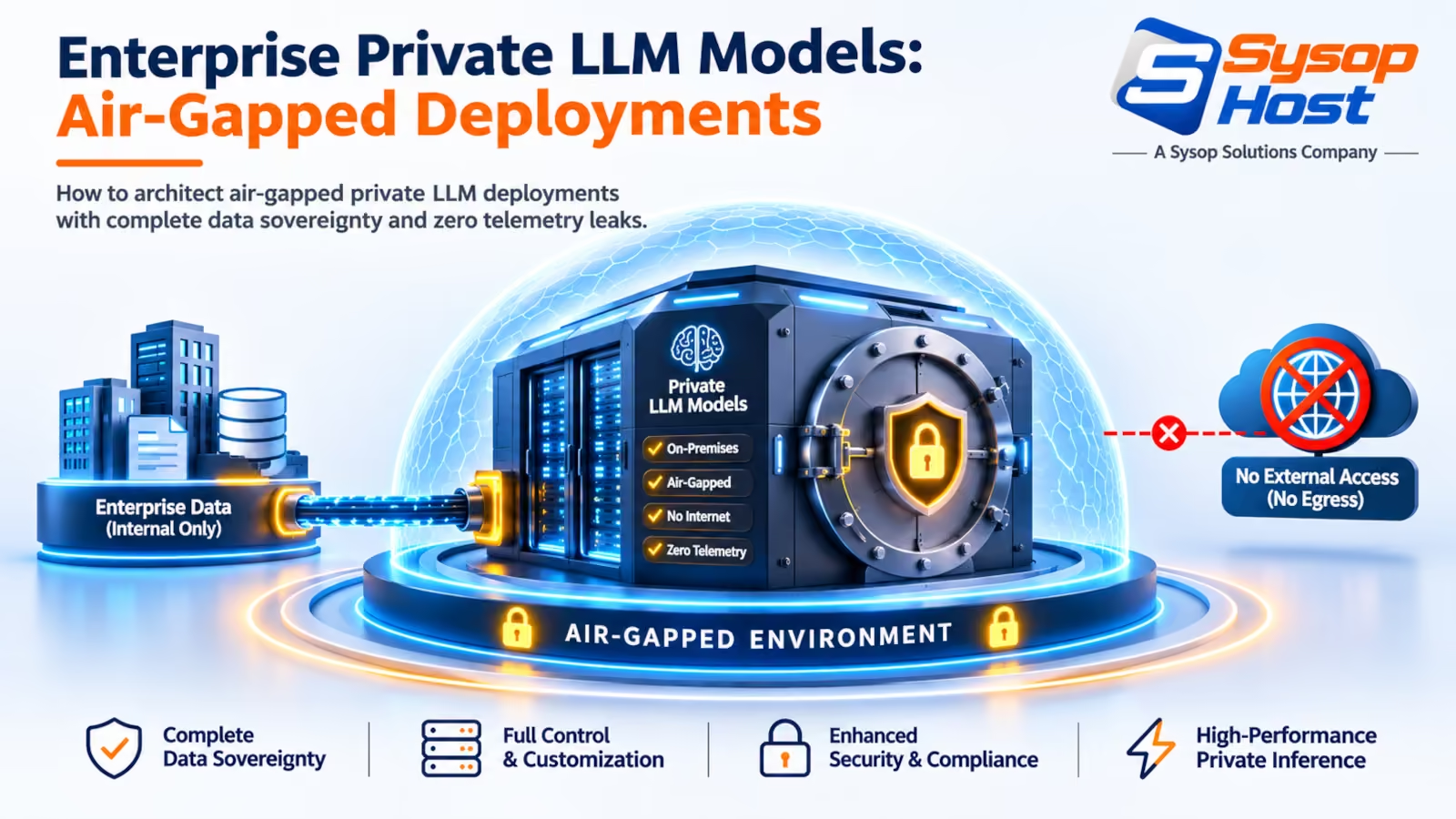
Sending corporate intellectual property or patient records to third-party AI endpoints exposes organizations to severe regulatory penalties and data breach liabilities. True sovereign AI demands isolated infrastructure where model weights run completely offline. Review the network architecture, weight verification protocols, and egress controls that keep enterprise intelligence private.
A hospital network integrates a commercial AI assistant into its pathology documentation pipeline. An oncologist pastes a biopsy summary containing an unredacted patient identifier into the prompt. Within milliseconds, that protected health record leaves the hospital's private subnets, traverses a commercial transit provider, and lands on multi-tenant servers governed by foreign cloud terms of service.
The hospital has just committed a reportable privacy breach.
Enterprise private llm models used to be a defence-contractor line item. HIPAA, GDPR and the EU AI Act dragged them into everyone else's budget. Under regulations like the European Union AI Act, HIPAA, and GDPR, transmitting sensitive customer records or proprietary trade secrets to external API endpoints introduces catastrophic liability [1].
Achieving true data sovereignty requires moving beyond cosmetic "private cloud" checkboxes. It demands an air-gapped or zero-egress architecture where model weights, inference memory, and contextual embeddings execute exclusively on dedicated physical hardware without an outbound internet route.
The legal and regulatory trap of commercial AI endpoints
Plenty of executives assume the "don't train on our data" toggle is legal immunity.
It isn't. From an architectural perspective, hosted commercial APIs suffer from three fatal compliance flaws:
Third-party data processing boundaries: Under GDPR Article 28, passing personal data to a vendor creates a sub-processor relationship. If that vendor transfers data across international borders (such as routing European queries through US inference clusters during capacity failovers), it violates cross-border data transfer laws.
Subpoena and discovery exposure: Commercial AI vendors operating under foreign jurisdictions are subject to government access laws (such as the US CLOUD Act), which can compel vendors to disclose stored server logs and prompt histories without alerting international data owners.
Implicit telemetry and cache logging: Even when models do not train on user prompts, cloud providers routinely log input metadata, IP addresses, and transient error traces for debugging and abuse monitoring. Those logs persist in central log aggregators beyond your enterprise retention controls.
For legal firms, medical providers, and fintech institutions, these realities make multi-tenant commercial endpoints unacceptable for production workloads.
Architecture Model | Transit Boundary | Compute Tenancy | Telemetry Exposure | Legal & Regulatory Status |
|---|---|---|---|---|
Public Cloud AI API | Public Internet / Third-Party WAN | Multi-tenant shared GPUs | Logged in external vendor databases | Foreign jurisdiction risk (CLOUD Act, GDPR Art. 28) |
Air-Gapped Private Node | Internal VLAN / Local mTLS | Single-tenant dedicated hardware | Zero outbound transmission | Sovereign data ownership (HIPAA, GDPR compliant) |
Defining sovereign AI: from VPC endpoints to true air gaps
Enterprise teams classify AI privacy across three distinct isolation levels:
Isolation Tier | Network Connectivity | Data Exposure Surface | Typical Workload Profile |
|---|---|---|---|
Tier 1: Private VPC Gateway | Inbound from VPC, Outbound blocked to public web | Low (restricted to internal cloud subnets) | Internal HR bots, internal code completion, non-sensitive reporting. |
Tier 2: Dedicated Physical Bare Metal | Private leased lines, zero virtualization neighbors | Minimal (physical tenancy isolation) | Financial modeling, confidential merger analysis, proprietary patents. |
Tier 3: Strict Air Gap | Physically disconnected from public networks | Zero (no physical or logical route to internet) | Defense analysis, classified research, core medical record processing. |
True air-gapping means the operating system hosting the model possesses no default gateway to the internet. Software updates, OS patches, and model weights are imported through rigorous out-of-band verification procedures.
Operating on isolated dedicated server hosting provides the physical boundary necessary to satisfy Tier 2 and Tier 3 compliance audits without shared hypervisor vulnerabilities.
Securing the model supply chain: provenance and weight hashing
When self-hosting an open-weight model like Llama, DeepSeek, or Qwen, where do the model weights come from?
Most developers simply run git clone or pull an image from Hugging Face. In an enterprise security environment, downloading untrusted binary blobs from public repositories is an unacceptable vulnerability vector.
A compromised model file can contain more than subtle parameter poisoning:
Pickle deserialization exploits: Older model formats (
.binfiles serialized using Python'spicklelibrary) can execute arbitrary remote shell commands the instant the model is loaded into memory [2].Weight backdoor injection: Malicious actors can fine-tune public weights to behave normally on standard benchmarks while outputting malicious code whenever a specific trigger phrase appears in the prompt.
Production supply chain checklist
Standardize strictly on SafeTensors: Never load pickled weights. The
safetensorsformat developed by Hugging Face stores raw tensor buffers safely and prevents arbitrary code execution during model loading.Verify SHA-256 checksums out-of-band: Calculate the SHA-256 hash of every downloaded weight shard and verify it against published cryptographic signatures signed by the model authors:
# Calculate SHA-256 checksum of downloaded model shards
sha256sum Llama-4-70B-Instruct-shard-00001-of-00030.safetensors

# Compare against author's signed release manifest
# Output must match the official release manifest byte-for-byte
Mirror to an internal air-gapped artifact repository: Once verified, store the model shards on an internal private registry (such as an on-premises Harbor or Nexus instance) accessible only via internal private IP addresses.
Network architecture: zero-egress VPCs and enclave isolation
An inference engine doesn't need internet access to generate tokens. Once weights are loaded into GPU memory, the inference server requires only two network pathways:
An inbound port (typically HTTPS/mTLS on port 8443) receiving user prompts from internal applications.
An outbound port streaming completions back to the originating client.
Every other outbound network route must be blocked at the firewall layer.
                           [Internal Enterprise Subnet]
                                        │
                                        ▼ (HTTPS / Mutual TLS)
                        ┌───────────────────────────────┐
                        │   Ingress Gateway Proxy       │
                        │   - Authenticates mTLS certs  │
                        │   - Enforces rate limits      │
                        │   - Scrubs input headers      │
                        └───────────────┬───────────────┘
                                        │ (Isolated VLAN)
                                        ▼
                        ┌───────────────────────────────┐
                        │   Inference Node (No WAN IP)  │
                        │   - vLLM / SGLang in Docker   │
                        │   - Dedicated GPU VRAM        │
                        │   - Read-only root filesystem │
                        └───────────────┬───────────────┘
                                        │
                                        ▼ (Egress Blocked)
                             [X] DENIED: Public Internet
Enforcing zero egress with host-level packet filters
Do not rely solely on cloud console security groups. Implement defense-in-depth by configuring kernel-level packet filtering directly on the host using nftables:
#!/usr/sbin/nft -f

table inet airgap_filter {
    chain input {
        type filter hook input priority 0; policy drop;

        # Allow local loopback traffic
        iif "lo" accept

        # Allow established internal connections
        ct state established,related accept

        # Allow incoming mTLS traffic from internal application gateway only
        ip saddr 10.240.10.50 tcp dport 8443 accept
    }

    chain output {
        type filter hook output priority 0; policy drop;

        # Allow local loopback traffic
        oif "lo" accept

        # Allow responses to established connections
        ct state established,related accept

        # Explicitly drop all other outbound traffic (Zero Internet Egress)
        reject
    }
}
Applying strict drop policies ensures that even if an attacker executes a prompt injection exploit attempting to trigger an HTTP webhook to an external listener, the kernel drops the packet immediately. Pairing this network posture with managed cybersecurity services and guidelines from our website security guide creates an impenetrable operational boundary.
Inference runtime hardening: neutralizing memory scraping
When an enterprise LLM executes on shared infrastructure, the primary attack surface is physical RAM and GPU Video RAM.
When a container finishes an inference request, GPU memory allocators do not automatically zero out memory pages for performance reasons. A secondary container sharing that GPU could theoretically allocate uninitialized VRAM and read residual prompt tokens processed by the previous session.
To prevent memory scraping:
Enforce single-tenant physical node allocation: Never run sensitive inference workloads on shared multi-tenant instances where unknown neighbors share physical PCIe buses.
Enable Confidential Computing hardware: On supported hardware (such as AMD SEV-SNP or NVIDIA H100 Confidential Computing), memory encryption keys are managed directly by hardware processors. Memory remains encrypted even against the host hypervisor and operating system root accounts [3].
Mount read-only container root filesystems: Configure the inference container with a completely read-only root filesystem (
readOnlyRootFilesystem: truein Kubernetes) and mount volatile tmpfs scratch disks for temporary caches. When the pod restarts, all scratch data vanishes.
Operational auditing: logging without leaking plaintext
Compliance frameworks require audit logging. You must prove who accessed the model, when they accessed it, and what authorizations were verified.
However, recording full prompt text and completion tokens in central log aggregators duplicates the exact data leakage problem you set out to solve.
Follow these logging rules for private AI deployments:
Log structural metadata only: Record timestamps, user ID hashes, client certificates, model IDs, token counts, and generation durations.
Hash sensitive prompts: Compute a SHA-256 hash of the input prompt and store the hash in the audit log. If a regulatory authority later questions whether a specific document was processed, you can hash the document to prove an exact match without storing plaintext copies in log stores.
Store volatile caches in encrypted volumes: If intermediate reasoning tokens or embeddings must be cached on disk, store them on LUKS-encrypted partitions backed by hardware TPM keys.
To ensure continuous uptime and resilient operations without risking external backups, implement isolated local snapshot policies using enterprise backup and disaster recovery services.
Deploy sovereign AI infrastructure with total data control
SysopHost provides single-tenant dedicated bare metal, private cloud environments, and hardened network architectures engineered for strict enterprise compliance and zero telemetry leakage.
Explore Dedicated Security InfrastructureComments
No comments yet. Be the first to comment!