 Arjun Mehta
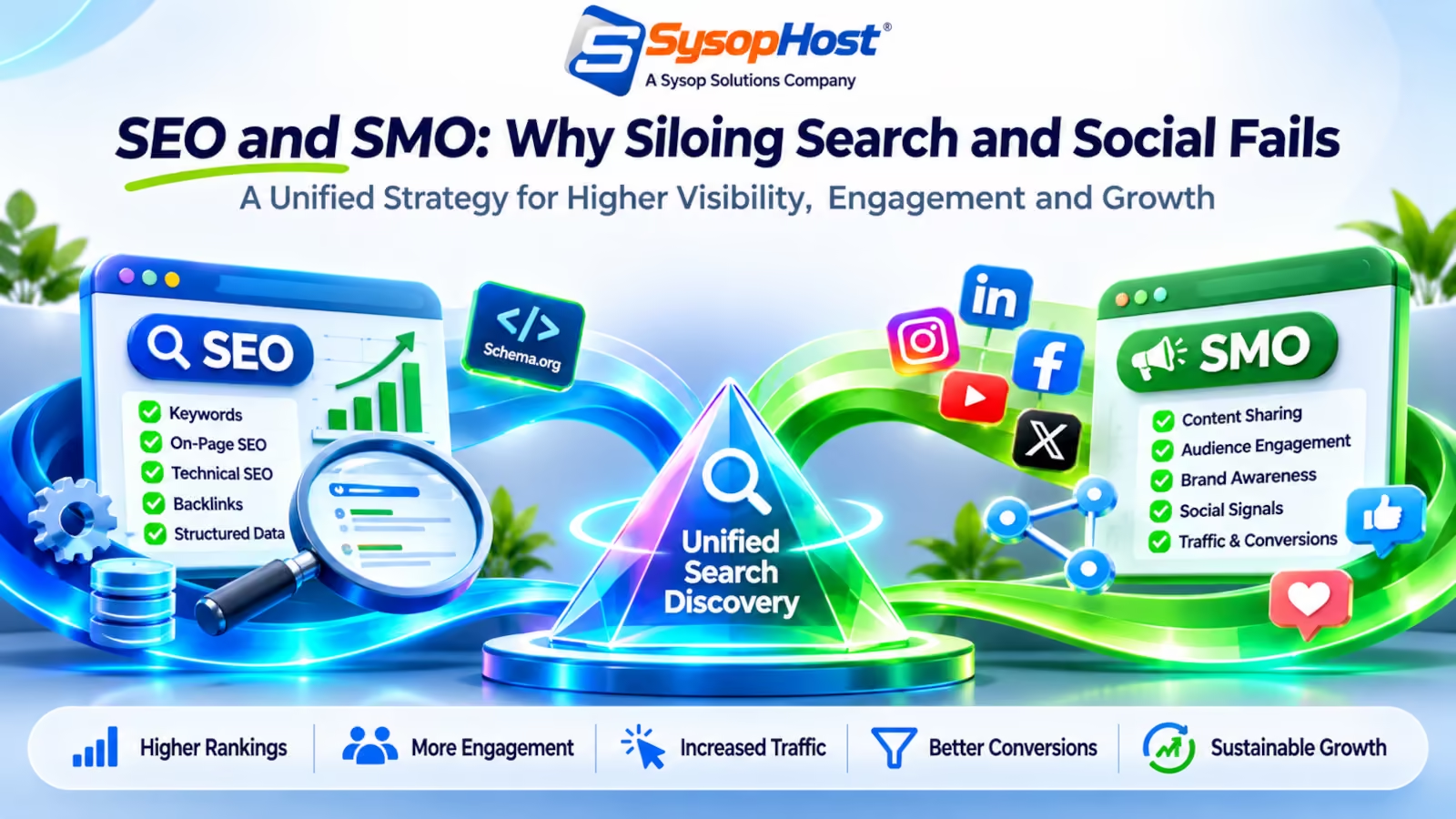
Search and social get run by different people, with different briefs, and the audience does not care. This is what the primary documentation says about signals, what social work can honestly claim, and the two technical failures that quietly cost reach.
A two-person ops team in Ambala runs sixty client sites. One of them owns search, the other owns social, and both are behind. The same article gets written twice: a long one for Google, then a chopped version for LinkedIn that links to the homepage. Six months in, organic traffic is flat and the LinkedIn posts mostly earn likes from people who never click.
The SEO and SMO split is not a channel problem. It is an org chart problem, and it is the usual reason small teams get nothing compounding out of either. The division made sense when search meant ten blue links and social meant a feed you scrolled for fun. Neither is true now. YouTube search returns videos by transcript match. Reddit threads often outrank vendor pages for "is X any good". Google's AI Overviews put forum posts next to official documentation. Your buyer moves through all of it in one session, and the systems doing the ranking read the same public web your social team is already posting into.
So the fix is not a bigger budget. It is one queue of work, aimed at places where the audience already searches, published on infrastructure that lets both a person and a machine reader get the page quickly.
What the primary documentation actually says
Every few months a conference talk claims that social shares are a ranking factor. The primary sources are calmer.
Google's documentation for AI Overviews and AI Mode tells site owners to apply the same foundational SEO practices as for Search overall. It also describes the technical bar as one thing: the page must be indexed and eligible to be shown with a snippet. There are no additional technical requirements [1].
On speed, the page experience documentation is careful in a way marketing decks are not. There is no single page experience signal. Core Web Vitals are used by the ranking systems, but good scores do not guarantee position, and Google says chasing a perfect score "just for SEO reasons" may not be the best use of your time [2].
Neither point means social work is pointless. It means the mechanism is indirect, and knowing which mechanism you are pulling separates a plan from a ritual.
Claim you hear | What the source says | What to do with it |
|---|---|---|
Likes and shares are a ranking factor | No social engagement signal appears in Google's AI features or page experience documentation | Treat social as distribution and proof, not a ranking lever |
AI Overviews need special optimisation | Being indexed and snippet-eligible is the whole technical bar | Fix crawlability before you buy an "AEO" retainer |
Page speed is the lever | Core Web Vitals feed ranking systems; good scores still do not guarantee position | Fund speed for conversion first, ranking second |
AI cites whoever is loudest on social | What a model can quote is what it can fetch and parse as text | Put the citable claim on a page you control |
Where social work feeds search, indirectly
Three mechanisms do the work, and each one is measurable.
Branded search is the first. Someone sees a post, does not click, and types your name into Google two days later. Those queries are in Search Console. Their trend is the cleanest read you get on whether social is doing anything at all, and because you already rank first for your own name, the impression count matters more than the click-through rate.
Links written by other people are the second. A post that a database engineer finds useful gets mentioned in a Slack, then in a thread, then in a blog post that links to your benchmark. The social link itself is not the prize. The link somebody else writes afterwards is.
The third is the consensus page. Reddit threads, YouTube videos with transcripts, GitHub issues and Stack Overflow answers are all pages that can be read and quoted. If your product appears in those pages accurately, the consensus is at least true. Google's guidance on helpful content states the underlying test plainly: content should show first-hand experience and make clear who made it, how, and why [3]. A thread that says "we run this in production, and this is what broke" passes that test in a way a landing page cannot.
Social platforms are search engines with worse documentation
YouTube is the easiest case because the mechanics are visible. A video's title, description, chapters and transcript are text, and text is what a query matches. A tutorial titled "Part 4: continuing our series" gives a search engine nothing to match against the phrase a viewer would actually type. Name the task in the title, put version numbers in the description, and add chapters so a 40-second answer can be found without watching twelve minutes.
Reddit rewards the opposite instinct. Title the thread as the question a person would type, answer it completely, and do not link your domain unless the link is the answer. Moderators remove promotion, and a removed thread has no search value at all.
LinkedIn is where B2B consensus is easiest to fake and easiest to lose. Reposting the same carousel with a different gradient reaches the people who already follow you and nobody else. A post that takes a position, names the trade-off and invites correction collects comments from people who know the subject, and those comments are the part everyone else reads.
None of that replaces having something worth saying. Twenty posts built on "five tips" will not rescue a product nobody needs.
The join that fails silently: previews and first response
Two technical failures cost social traffic without appearing in any marketing dashboard.
The first is the link preview. When a URL is pasted into Slack, LinkedIn or X, the platform fetches the page and builds a card from metadata in the HTML head. The Open Graph protocol expects og:title, og:type, og:image and og:url there [4]. On a client-rendered app, the first response is often an empty shell plus a script tag, so the card comes back blank or generic. Google's JavaScript guidance explains how much work client-side rendering pushes onto a crawler [5], and a social fetcher is less patient than Googlebot.
What a fetcher gets on the first request:

Server-rendered page              Client-rendered SPA
┌────────────────────────┐        ┌────────────────────────┐
│ <head> og:title, ...   │        │ <div id="root"></div>  │
│ <body> headline, image │        │ <script src="app.js">  │
└───────────┬────────────┘        └───────────┬────────────┘
            ▼                                 ▼
    Rich preview card              Blank or generic card
The fix is server rendering, or a small reverse proxy in front that answers known bot user agents with prerendered HTML. Both are hosting decisions rather than marketing ones.
The second failure is time to first byte. A campaign that sends 8,000 visitors to a page whose server takes two seconds to start answering has paid for 8,000 people to stare at white space. The numbers pages are measured against are the Core Web Vitals thresholds: LCP within 2.5 seconds and INP at 200 milliseconds or less [6]. Failing both on a mobile connection turns a good post into a bounce report.
If speed is the part you want to fix first, the mechanics are in why website speed matters for SEO.
Running both as one queue
Four changes, ordered by payback.
Build one topic map from both places. Pull your top commercial queries out of Search Console, then type each one into YouTube and Reddit and note what comes back. Any topic that returns results in both is worth one deep page.
Make one asset, then cut it up. Write the page for the person who will read it, then cut the same argument into a three-minute video, a carousel built from the table, and a thread that states the position. Four formats, one research pass.
Give the preview an owner. Somebody has to own the Open Graph tags and the prerender check, or nobody will. Test the live URL in each platform's inspector before a campaign, not after.
Keep one dashboard. Branded impressions, assisted conversions from social referrals, and the answer-engine citations you check by hand. A dashboard with thirty tiles gets read by nobody.
The work is the same work you were already doing. What changes is that the research happens once and the output lands in four places instead of two.
Who this is not for: a plumber with one service page and one city. For that business, a complete Business Profile, a fast page and three photos of real jobs will beat any content calendar. Social is answering reviews, not publishing a series. If you want the campaign planning side handled, that sits under digital marketing; the crawl, preview and speed audit sits under AI SEO and SMO. For the wider shift in how small teams get found, see how AI is transforming small businesses.
What to measure, and what to ignore
Ignore follower counts and impressions. They move for reasons unrelated to revenue and cannot be defended in a budget meeting.
Watch four numbers: branded search impressions, non-brand clicks to the pages you actually wrote, referrals from social that reach a second page, and the share of those referrals that convert. If branded impressions climb while non-brand clicks stay flat, the social side is working and the on-site side is not, which is the easier problem of the two.
Is your hosting costing you the traffic you already paid for?
Managed cloud hosting with 99.99% uptime and 24/7 engineer support, for the days a post outperforms the plan.
See cloud hosting plansComments
No comments yet. Be the first to comment!