 Neha Sharma
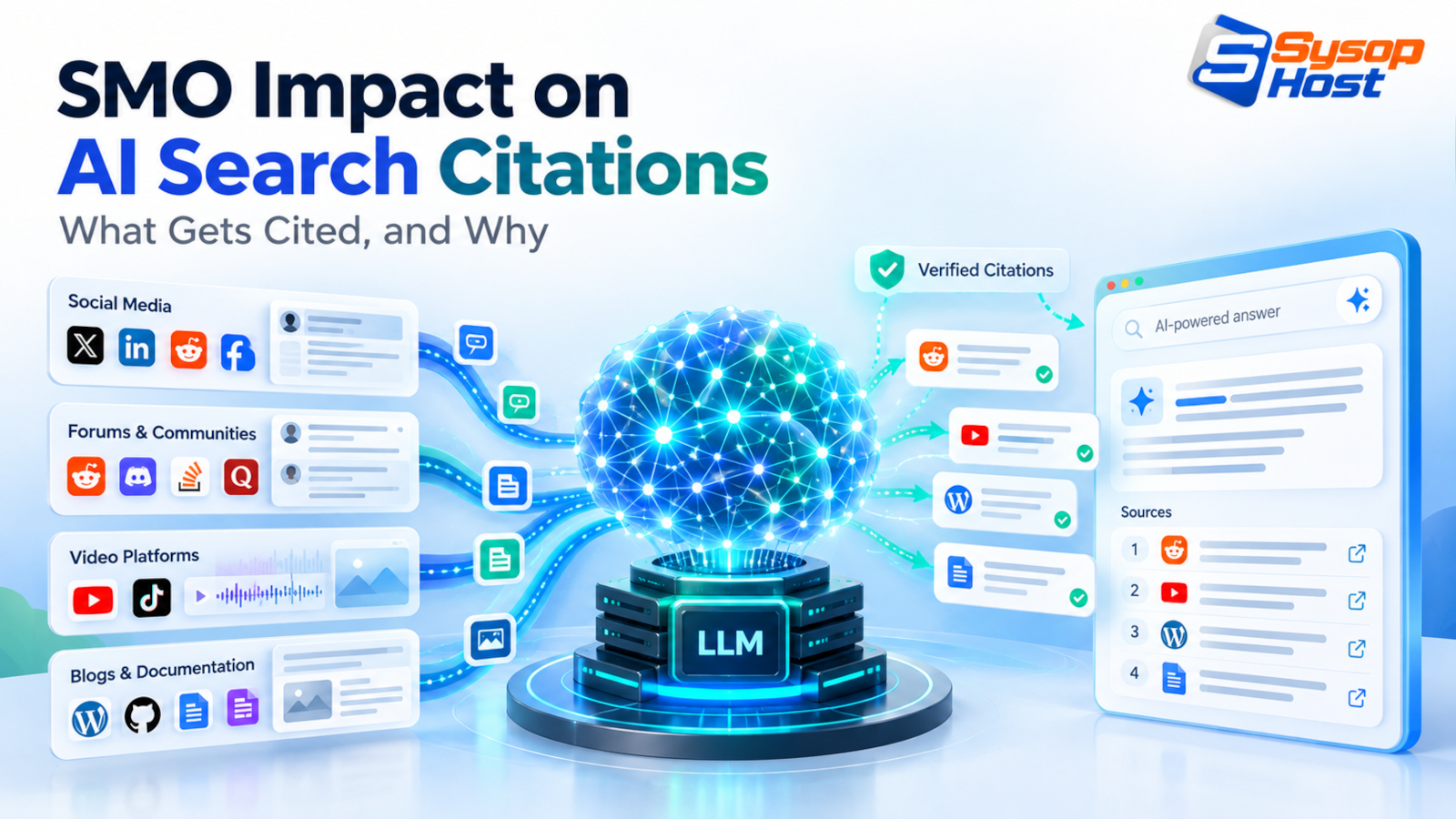
The popular story about the SMO impact on AI search is that answer engines weigh your social presence. The documentation says something narrower and more useful: which pages can be fetched, parsed and quoted. This separates the documented behaviour from the observation, and covers the access and latency that decide it.
Someone asks an assistant for a shortlist of managed hosts that can survive a traffic spike. The answer names three companies and cites a Reddit thread, a documentation page and a YouTube walkthrough. One of the three is described as "fine until you need support at 2am". That sentence came from a forum post written by one person two years ago.
That is the actual problem the phrase SMO impact on AI search refers to. You are not optimising for a ranking position any more. You are trying to be described accurately in an answer assembled from pages other people wrote.
The explanation you hear most often is that the engines weigh your social presence directly. The documentation does not say that, and the difference matters, because it changes what you would spend money on. What the docs do describe is narrower and more useful: which pages an engine can fetch, parse and quote, and which controls decide that.
What Google documents about AI answers
Google's guidance for AI Overviews and AI Mode is short and unusually plain. Site owners should apply the same foundational SEO practices as for Search overall. The technical bar is one condition: the page must be indexed and eligible to be shown with a snippet. There are no additional technical requirements [1].
Two details in that page are worth more than most conference talks. Responses may use a query fan-out step, running several related searches and then selecting supporting pages from the index. And the control that decides whether your content appears is the robots.txt directive for Googlebot, not a special AI token.
That last point is where a lot of bad advice starts. Google-Extended is not a crawler. It has no separate HTTP user agent; crawling is done with existing Google user agents, and the token exists so publishers can control whether their content trains future Gemini models or grounds Gemini apps. Google states that it does not affect a site's inclusion in Search and is not a ranking signal [2]. Adding an allow rule for it to reach AI Overviews does nothing.
Claim you will hear | What the documentation says |
|---|---|
"You need an AEO or GEO overhaul for AI answers" | Indexed and snippet-eligible is the technical bar; existing SEO fundamentals are what Google recommends |
"Allow Google-Extended to appear in AI Overviews" | It is a robots.txt control token for Gemini training and grounding, with no effect on Search inclusion |
"AI Overviews reward social posts" | No social engagement signal is documented. What is documented is which pages can be fetched and quoted |
"Blocking AI bots protects your rankings" | The Search control is Googlebot's robots.txt rules; training controls sit elsewhere |
Both columns summarize the two Google pages cited above.
What Perplexity and OpenAI document
Perplexity publishes two relevant user agents. PerplexityBot is described as surfacing and linking sites in its search results, and Perplexity's docs explicitly say it is not used to crawl content for foundation models. Perplexity-User handles fetches triggered by a person asking a question, and because the user requested it, that fetcher generally ignores robots.txt [3].
OpenAI's crawler documentation makes a similar split. OAI-SearchBot exists to surface sites in ChatGPT's search results, and sites that opt out will not be shown in search answers, though they may still appear as navigational links. GPTBot is the training control, and the two settings are independent. OpenAI also notes that a robots.txt change can take about a day to propagate [4].
Neither vendor documents social signals as an input to citation. If a deck gives you a percentage for how much more often socially active brands get cited, ask which page states it. The honest position is that the mechanism is indirect and largely unmeasured, and the parts you can control are the parts worth working on.
Where social consensus actually enters the pipeline
It enters as pages. A retrieval system does not read "sentiment"; it fetches documents, splits them into passages, and picks passages that answer the query. A Reddit thread, a YouTube page with a transcript, a GitHub issue and a Stack Overflow answer are all documents. A brand's LinkedIn post is also a document, which is why the useful question is not "how do we look popular" but "what text about us exists, and can it be fetched".
Run the same commercial query in three engines and look at the citation chips. You will see forum threads and video pages in the mix, and that is observable rather than secret. The reason is mundane: those pages contain specific, first-hand, query-shaped sentences.
That gives you three pieces of work, and none of them is a growth hack.
Be in the threads that already exist. Answer the actual question with the detail only an operator has, including what broke. Do not link your domain unless the link is the answer; moderators remove promotion, and a removed thread contributes nothing.
Make the citable sentence exist on your own pages. If a claim about your product only exists in a hero headline, there is nothing for a passage-level retrieval system to lift. Put the version numbers, limits and trade-offs in text.
Keep the entity facts consistent. Name, domain, product names and author bios should match across your site, your documentation and the profiles you control. Structured data helps here, and sameAs is the property that tells a knowledge graph which profiles refer to the same organisation [5].
What a retrieval pass can use          What it cannot use
─────────────────────────────────      ─────────────────────────
forum thread with detail               a carousel with no text
video page with transcript             an image of a quote
docs page with limits                  a login wall
Entity data, briefly
The JSON-LD below is the minimum that makes the entity unambiguous. Replace the profile URLs with ones you actually control and keep them current, because a stale profile is a contradiction rather than a signal.
{
  "@context": "https://schema.org",
  "@type": "Organization",
  "name": "<your company>",
  "url": "<your homepage>",
  "sameAs": ["<your LinkedIn company page>", "<your GitHub org>"]
}
Two rules matter more than the markup. The structured data has to match the visible page, which Google lists among its SEO fundamentals for AI features. And the facts have to be the same facts everywhere, because inconsistency is what produces a confident answer about the wrong product.
Crawler access, configured on purpose
If the goal is being cited in search answers, the search-oriented agents need to reach the page. Both vendors publish the recommendation directly: allow PerplexityBot and OAI-SearchBot in robots.txt, and permit their published IP ranges if a WAF is in front of the site.
# search-oriented agents: allow
User-agent: PerplexityBot
Allow: /

User-agent: OAI-SearchBot
Allow: /

# training crawlers: your call, not a Search decision
User-agent: GPTBot
Disallow: /
Blocking GPTBot and allowing OAI-SearchBot is a coherent position: no training data, yes to being linked in an answer. Blocking both is also coherent, if you have decided the trade is worth it. What is not coherent is an aggressive rate limiter that treats a burst of fetches from a published IP range as an attack, which is the failure mode that shows up after a launch rather than before it.
The infrastructure half nobody budgets for
A crawler's patience is a function of your server. Google's guidance on JavaScript covers how much work client-side rendering pushes onto a crawler [6], and a retrieval system assembling an answer under time pressure is less forgiving than an indexer with a queue. If the first response is an empty shell, the passage that would have answered the query does not exist for that fetch.
Two things are worth checking this week. Does the URL return real text in the raw HTML, without executing scripts? And how long does the server take to start answering? The Core Web Vitals thresholds give you a target to aim at for people, though Google is clear that good scores do not guarantee rankings. For machines, raw text in the first byte matters more than any score.
The practical setup is server rendering or a prerender proxy for bot user agents, a page that is fast from a cold cache, and a firewall that distinguishes a crawler from an attack. If you want the speed side in detail, it is covered in why website speed matters for SEO, and the hosting side in cloud hosting.
Measuring something that does not have a dashboard
The SMO impact on AI search story has no dashboard. Google reports traffic from AI features inside the ordinary Search Console performance report rather than as a separate channel, so you cannot isolate it with a filter and should stop trying. Measure proxies instead.
Watch branded impressions, because an answer that describes you accurately tends to be followed by a search for your name. Watch which of your pages earn links from forum threads, since those are the pages a retrieval pass is most likely to surface. And check by hand, monthly, on the ten queries that matter: run each in Google, Perplexity and ChatGPT, note whether you appear, and read the sentence attached to your name. That log is more useful than any citation-frequency metric sold as a service.
Who this is not for: a business with no third-party discussion of any kind and no product detail worth quoting. You cannot manufacture consensus, and the attempt reads as astroturfing to moderators and to models trained on spam classifiers. In that case the work is documentation, not distribution.
If you would rather have the entity, crawler and speed work done in one pass, that is what AI SEO and SMO covers, and the wider shift in how smaller companies get found is in how AI is transforming small businesses.
Want the crawler, entity and speed work done in one pass?
Our AI SEO and SMO service covers the crawl, entity and speed work described here.
See the AI SEO and SMO serviceComments
No comments yet. Be the first to comment!